

 Forklift LiFePo4 Battery
 Golf Cart LiFePo4 Battery
 Battery Charger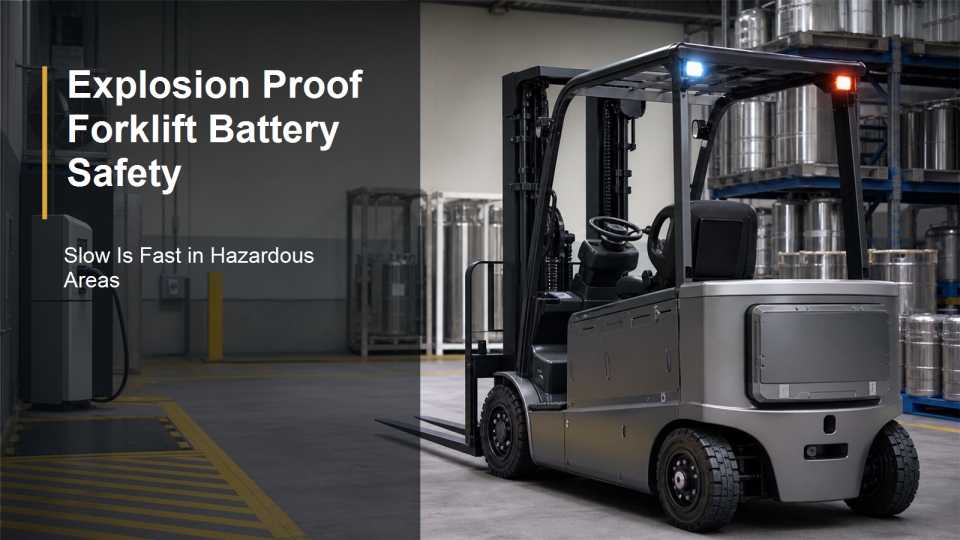
Table of Contents
Explosion proof forklift battery safety starts with a hard limit. In a hazardous area, the truck must not become an ignition source. Speed still matters. Also, load capacity matters. Yet both come after spark control, surface temperature, battery protection, and certified design.
This is why an explosion-proof forklift can feel restrained. The truck may run slower. Turning can take more space. In addition, the purchase price often sits far above a standard truck. The point is not to impress the operator. Instead, the truck must work near solvents, vapor, dust, or reactive materials without adding one more risk.
Why Explosion-Proof Forklifts Are Different
A normal forklift puts productivity first. More torque. Faster travel. Shorter loading cycles. By contrast, an explosion-proof forklift follows another rule. It must reduce the chance of ignition across the whole machine.
The problem is not theoretical. A forklift has many possible ignition sources. Electrical contacts can arc, while motors and brakes can create heat. Static can build up on tires. Metal impact can spark. Meanwhile, a hydraulic leak can create oil mist, and a battery fault can become a thermal event.
In a clean warehouse, managers may treat those risks as ordinary equipment hazards. However, in a chemical plant, paint workshop, distillery, powder warehouse, battery electrolyte room, or grain-handling area, the same risks carry a different weight.
Explosion Proof Forklift Battery Safety Depends on the Site
A label alone cannot prove the battery safety case. The site must come first. Therefore, buyers need to know the hazardous substance, its gas group, its ignition temperature, the zone classification, and the task profile.
Standards usually divide gas environments into Zone 0, Zone 1, and Zone 2. In practice, mobile industrial trucks normally belong in Zone 1 or Zone 2 work, not inside vessels or spaces where explosive gas remains present for long periods. Dust environments follow a similar idea: Zone 20, Zone 21, and Zone 22.
That classification decides the protection level. It also tells the buyer whether the truck, battery, charger, connector, display, sensors, lights, alarms, and cabling fit the job.
The Ex Marking Is Not Decoration
A compliant truck should carry a clear Ex marking. One common style is Ex de IIB T4 Gb. In practice, each part matters.
- Ex shows that the manufacturer designed the equipment for explosive atmospheres.
- d means flameproof protection.
- e means increased safety.
- i means intrinsic safety when used on low-energy circuits.
- IIB refers to a gas group. IIC covers more easily ignited gases such as hydrogen and acetylene.
- T4 limits the maximum surface temperature to 135 degrees Celsius.
- Gb points to an equipment protection level for Zone 1 gas areas.
For buyers, the mark should match the site report. If a workplace needs IIC or T5, an IIB T4 truck is not an upgrade. It is simply the wrong machine.
Four Protection Ideas Behind the Truck
Explosion-proof design usually combines several methods. First, flameproof protection puts parts that may spark inside a strong enclosure. If ignition happens inside, the flame cannot escape through the flame path.
Next, increased safety works earlier in the chain. It reduces the chance of arcs, hot spots, and insulation failure through stronger electrical design. Intrinsic safety goes further by limiting circuit energy, so a fault cannot release enough energy to ignite the atmosphere.
Finally, dust protection focuses on sealing and temperature. Fine powders can settle on surfaces, trap heat, and ignite. For that reason, a sealed enclosure and a controlled surface temperature are not details. They are the design.
Diesel, Lead-Acid, and Lithium: Different Trade-Offs
Older explosion-proof fleets often used diesel trucks for outdoor heavy work. For example, diesel has strength in heavy outdoor tasks. However, it also brings exhaust heat, hot surfaces, emissions, and noise. In many sites, those limits matter more than raw pulling power.
Lead-acid electric forklifts became common indoors. They avoid exhaust. However, charging can release hydrogen. Therefore, many sites need a controlled charging room, ventilation, gas monitoring, and strict operating rules.
Lithium batteries changed the discussion. A sealed lithium ion forklift battery can remove the routine hydrogen issue associated with flooded lead-acid charging. Lithium iron phosphate chemistry also has better thermal stability than many high-energy chemistries. Even so, lithium is not automatically safe in an explosive atmosphere.
The pack must manage overcharge, overdischarge, short circuit, overcurrent, high temperature, and cell fault propagation. In many designs, the BMS uses intrinsically safe circuits. At the same time, the enclosure, cabling, connector, and thermal path still need the same disciplined engineering.
Why Lithium Is Gaining Ground
Explosion-proof lithium forklifts are gaining share in small and mid-size indoor work. Here, the reasons are practical. Sealed packs reduce watering and hydrogen management. In addition, opportunity charging can reduce battery swaps. Voltage stays steadier under load, and maintenance is cleaner.
That does not remove the approval work. Instead, it shifts the questions. Buyers should ask how the pack controls heat, how the design contains cell failure, how the BMS protects itself, and whether the certification covers the whole truck as a system.
Baufar’s forklift battery terms guide helps purchasing teams read Ah, Wh, voltage, C-rate, SOC, and SOH without guessing. For hazardous-area work, those terms sit beside Ex rating and zone classification.
Where Lead-Acid Still Appears
Lead-acid is familiar. It is serviceable. Some sites already have charging rooms and trained maintenance teams. In those cases, buyers should judge a change to lithium by risk, workflow, certification, charger location, and cost, not fashion.
Still, hydrogen during charging remains a serious planning point. Battery rooms need ventilation and control. Operators need rules that work on slow days, night shifts, and urgent production runs. After all, safety does not only fail during dramatic moments. It often fails during routine work.
AGV and Unmanned Explosion-Proof Forklifts
Unmanned forklifts are also entering hazardous-area projects. The reason is simple. If a task can remove people from a risky zone, the value goes beyond labor saving.
Autonomous trucks still need certified hardware. Sensors, controllers, communication modules, batteries, charging contacts, and emergency systems must fit the area classification. Software does not cancel physics. Instead, it changes who faces the work.
Baufar’s electric forklift battery technology article explains why buyers should review cells, pack design, BMS logic, charger matching, and real operating conditions together.
Buyer Checklist for Hazardous-Area Forklift Projects
- Confirm the site zone classification before discussing truck price.
- Match the Ex marking to the gas group, dust risk, and temperature class.
- Check the certificate number, test report, nameplate, and scope of approval.
- Review whether the approval covers the battery, charger, connector, BMS, lights, sensors, and controls.
- Do not accept a standard truck with only labels, covers, or partial changes.
- Ask how the design controls thermal runaway, hydrogen, static, braking heat, and cable faults.
- Plan maintenance with qualified personnel and approved replacement parts.
- Keep charging rules separate for ordinary areas and classified hazardous areas.
What Baufar Buyers Should Take From This
Explosion proof forklift battery safety is not a single component choice. It is a system choice. The battery pack matters. So do the truck structure, electrical protection, charger, operating zone, maintenance discipline, and certification file.
A standard electric forklift battery may be right for a normal warehouse. A hazardous area needs a different conversation. Start with the atmosphere. Then select the truck. Finally, approve the battery system. That order saves time, and sometimes more than time.
Featured Forklift LiFePo4 Battery
48V Forklift Battery
51.2v 460Ah Forklift Lithium Battery For BT RR-M6
48V Forklift Battery
Nichiyu FB25PN-75 Forklift Lifepo4 Battery 48V 460Ah
80V Forklift Battery
Forklift Lithium-ion Battery 80v 404Ah for Toyota 7FB30-7FBJ35
48V Forklift Battery
Forklift Lithium Battery 51.2v 404Ah for Still FM-X
48V Forklift Battery
48V 519Ah Lifepo4 Lithium Battery for Heli CPD20/25-GB2/GD Forklift
80V Forklift Battery
80V 404Ah Lifepo4 Lithium Battery for CPD30/35-G1/G3 Forklift
80V Forklift Battery
80V 560AH Lifepo4 Lithium Battery for HELI CPD35-GD2
80V Forklift Battery
80V 600Ah LiFePO4 Lithium Battery for NICHIYU FBC25/30P Forklift