

 Forklift LiFePo4 Battery
 Golf Cart LiFePo4 Battery
 Battery Charger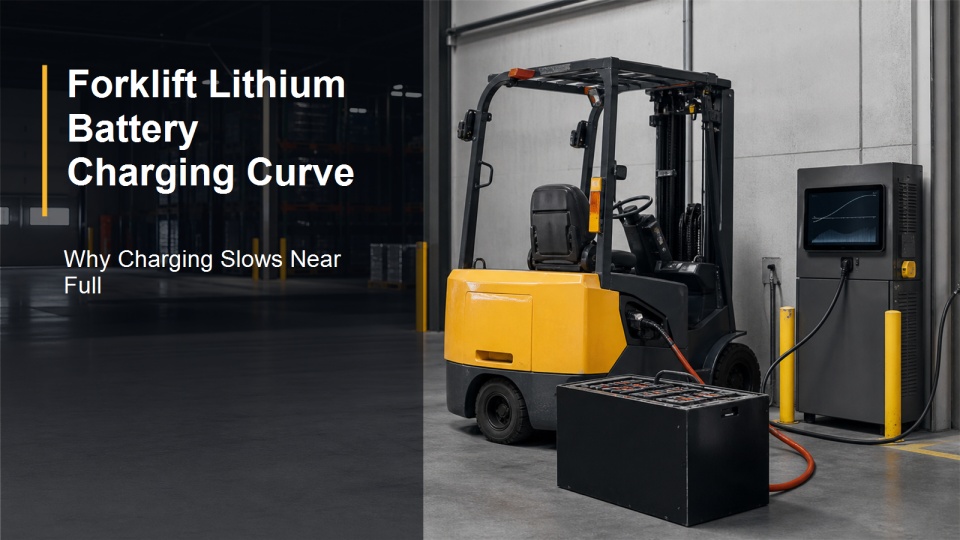
Table of Contents
A forklift lithium battery charging curve is rarely a straight line. The first part often looks fast. Near full charge, the speed drops. This does not always point to a weak charger or a tired battery.
In many cases, the system slows down on purpose. The charger, battery management system, and cells are trying to finish the charge without pushing voltage, heat, or cell balance beyond the safe range.
Why the First Stage Charges Faster
Most lithium-ion batteries use a constant-current and constant-voltage charging method. In the constant-current stage, the charger supplies a set current. Battery voltage rises as energy goes into the pack.
This stage carries most of the useful energy refill. As a result, SOC can climb quickly during the early and middle part of charging. For a busy warehouse, this is the valuable part of the charging window.
That is why a forklift can recover a meaningful amount of runtime during a lunch break or shift change. The battery can accept higher current while voltage and temperature remain inside the allowed range.
Why Charging Slows Near Full
Once pack voltage approaches the upper limit, the charger moves into constant-voltage control. At that point, it holds the target voltage and lets current taper down.
Current falls, so charging power falls as well. Therefore, the last part of the charge takes longer. This is normal behavior for many lithium ion forklift battery systems.
The simple version is easy to remember: the battery drinks quickly when it has room, then slows down near full. Still, the exact changeover point is not always 80%. That number is only a practical shortcut.
The 80% Rule Is Not a Fixed Boundary
Some operators say lithium batteries charge fast to 80%, then slow down. That can be useful on the shop floor. However, it is not a universal rule.
The real transition depends on cell chemistry, charge rate, pack temperature, SOC calculation, cell voltage spread, BMS settings, and charger strategy. Two packs with the same capacity can show different curves.
For this reason, buyers should not judge a battery only by one charging-time claim. They should ask for a charge profile under realistic warehouse conditions.
How the BMS Controls Charging Current
The BMS does more than watch total pack voltage. It checks each series cell group, temperature sensor, current signal, and protection limit.
If one cell group reaches the voltage ceiling early, the BMS may request lower current. If temperature moves outside the approved window, it can also reduce current or stop charging. In practice, the weakest cell group can decide the pack limit.
This is why cell consistency matters. A well-matched lithium traction battery pack can stay in the high-efficiency charging range longer. A pack with larger cell voltage spread may enter tapering earlier.
Bigger Chargers Cannot Remove the Taper
A higher-power charger can help during the constant-current stage. It cannot erase the constant-voltage stage.
Fast charging research points to a simple constraint. The allowed charge current depends on cell voltage, temperature, and internal electrochemical state. More current is not always better.
For an electric forklift battery, the charger must follow the battery system. If the BMS asks for less current, a larger charger should still reduce output. Otherwise, speed turns into risk.
What This Means for Opportunity Charging
For multi-shift forklift fleets, opportunity charging for forklifts does not always mean charging to 100% every time. Often, the better move is to use short breaks for the part of the curve where the battery accepts energy efficiently.
A lunch break, loading pause, or shift handover can add useful runtime. Later, the fleet can decide whether a full charge is necessary before the next duty cycle.
This approach improves charging time utilization. It also avoids treating the slow final stage as wasted charger power. The charger is not idle. It is following the battery.
Buyer Checklist for Charging Efficiency
- Ask for the full charge curve, not only the total charging time.
- Check the constant-current duration under the expected charger power.
- Review when current tapering starts and why.
- Confirm BMS limits for voltage, temperature, overcurrent, and cell imbalance.
- Compare charging performance at normal, cold, and hot warehouse temperatures.
- Plan opportunity charging around real breaks and shift changes.
- Match charger output to the pack’s approved charge rate.
- Use kWh recovered per charging window as a practical forklift battery charging efficiency metric.
How Baufar Reads a Forklift Lithium Battery Charging Curve
A mature forklift lithium battery charging curve should balance three things: refill speed, battery life, and safety. The system should accept current quickly when conditions allow it. Then it should slow down when voltage, temperature, or cell balance requires control.
For buyers, the question is not whether the final stage slows down. It should. The better question is whether the pack, BMS, and charger use the available charging window well.
Baufar’s forklift battery terms guide helps teams compare Ah, Wh, C-rate, SOC, and SOH. Baufar’s electric forklift battery technology article also explains why battery performance depends on the pack, charger, BMS, and worksite together.
Featured Forklift LiFePo4 Battery
48V Forklift Battery
51.2v 460Ah Forklift Lithium Battery For BT RR-M6
48V Forklift Battery
Nichiyu FB25PN-75 Forklift Lifepo4 Battery 48V 460Ah
80V Forklift Battery
Forklift Lithium-ion Battery 80v 404Ah for Toyota 7FB30-7FBJ35
48V Forklift Battery
Forklift Lithium Battery 51.2v 404Ah for Still FM-X
48V Forklift Battery
48V 519Ah Lifepo4 Lithium Battery for Heli CPD20/25-GB2/GD Forklift
80V Forklift Battery
80V 404Ah Lifepo4 Lithium Battery for CPD30/35-G1/G3 Forklift
80V Forklift Battery
80V 560AH Lifepo4 Lithium Battery for HELI CPD35-GD2
80V Forklift Battery
80V 600Ah LiFePO4 Lithium Battery for NICHIYU FBC25/30P Forklift