


 Forklift LiFePo4 Battery
 Golf Cart LiFePo4 Battery
 Battery Charger
Electric Forklift
Why High-Voltage Electric Forklifts Are Gaining Attention in Heavy-Duty Applications
Table of Contents
In recent years, the shift toward the electric forklift has accelerated across the material handling industry. However, this transition is no longer driven by sustainability goals alone. Instead, companies are now focusing on performance, uptime, and long-term operational efficiency.
The launch of Jungheinrich’s high-voltage electric forklift clearly reflects this shift. More importantly, it shows how electric solutions are moving into areas that were traditionally dominated by internal combustion forklifts.
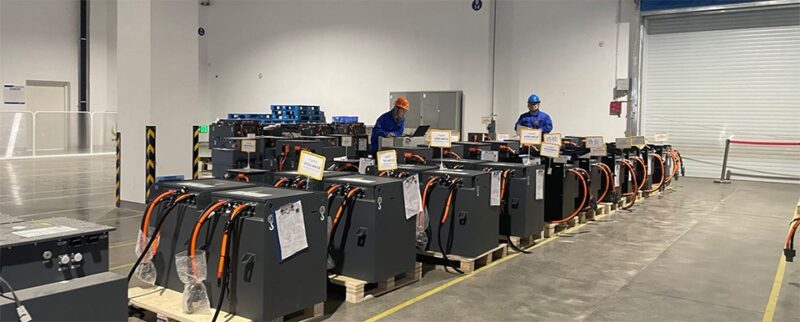
Electric Forklifts Are Expanding Into Heavy-Duty Work
In the past, many operators believed that electric forklifts were better suited for light or indoor applications. However, this perception is changing quickly.
With the introduction of high-voltage systems, electric forklifts can now handle:
heavier loads
longer operating hours
more demanding warehouse conditions
As a result, companies are starting to reconsider where electric equipment can be applied.
Performance Is No Longer the Limiting Factor
Modern electric forklifts now deliver:
strong torque output
stable lifting performance
consistent power during long shifts
Because of this, performance is no longer the main concern. Instead, companies are focusing on reliability and system stability.
Lithium-Ion Battery Technology Is Driving the Change
At the core of this shift is the rapid development of lithium-ion battery technology.
Compared with traditional lead-acid batteries, lithium systems offer:
higher energy density
faster charging capability
longer cycle life
reduced maintenance requirements
In practice, these advantages translate into better uptime and fewer operational interruptions.
Battery Strategy Is Now About Workflow Stability
Today, companies do not evaluate batteries based on specifications alone. Instead, they ask:
Will the battery support continuous operation?
Can it reduce downtime between shifts?
Does it simplify daily maintenance?
This is where solutions like taven battery systems become relevant. Rather than focusing only on capacity, these systems are designed to support real forklift usage and improve operational consistency.
Safety and Control Are Becoming More Important
At the same time, safety remains a key consideration in heavy-duty applications.
Modern electric forklifts now include:
stability control systems
improved operator visibility
ergonomic control layouts
These features help reduce operational risk, especially when handling heavy loads.
However, safety is not only about equipment design. It also depends on how well the system performs under real working conditions. Stable power output and predictable behavior are equally important.
Total Cost of Ownership Is Driving Adoption
Although electric forklifts often require higher upfront investment, the long-term cost benefits are becoming more evident.
In many cases, companies can reduce costs through:
lower energy consumption
reduced maintenance needs
longer battery lifespan
As a result, the focus has shifted toward total cost of ownership (TCO) rather than initial purchase price.
Lower Maintenance Is a Key Advantage
Unlike internal combustion forklifts, electric models have fewer mechanical components. Therefore, they typically require less maintenance.
In addition, lithium battery systems further reduce:
manual intervention
servicing frequency
unexpected downtime
This is why more companies are considering electric forklifts as a long-term investment rather than a short-term cost.
Industry Trend: From Equipment to System Thinking
Another important shift is how companies approach forklift procurement.
Instead of evaluating individual machines, buyers are now looking at the entire system, including:
battery compatibility
charging infrastructure
workflow integration
maintenance support
Because of this, forklift selection has become part of a broader operational strategy.
Preparing for the Transition to Electric
For companies planning to adopt electric forklifts, preparation is essential.
This usually includes:
training operators
upgrading charging infrastructure
evaluating warehouse workflows
selecting compatible battery systems
Without proper preparation, even advanced equipment may not deliver expected results.
What This Means for Real Operations
In practice, the move toward high-voltage electric forklifts is not just about technology. It is about improving operational stability.
Companies that successfully adopt electric solutions typically focus on:
reducing downtime
improving energy efficiency
simplifying maintenance
ensuring system compatibility
This approach allows them to achieve more predictable and efficient operations.
Conclusion: Electric Forklifts Are Redefining Heavy-Duty Applications
In conclusion, the introduction of high-voltage electric forklifts marks an important step in the evolution of material handling.
Electric forklifts are no longer limited to light-duty work. Instead, they are becoming a viable solution for heavy-duty applications.
More importantly, the focus is no longer on whether to switch to electric. The real question is:
👉 Which electric system can best support your operation?
Solutions that combine reliable equipment with well-matched battery systems—such as taven battery—can play a key role in improving uptime and long-term efficiency.
Featured Forklift LiFePo4 Battery
48V Forklift Battery
Nichiyu FB25PN-75 Forklift Lifepo4 Battery 48V 460Ah
80V Forklift Battery
Forklift Lithium-ion Battery 80v 404Ah for Toyota 7FB30-7FBJ35
48V Forklift Battery
Forklift Lithium Battery 51.2v 404Ah for Still FM-X
48V Forklift Battery
48V 519Ah Lifepo4 Lithium Battery for Heli CPD20/25-GB2/GD Forklift
80V Forklift Battery
80V 404Ah Lifepo4 Lithium Battery for CPD30/35-G1/G3 Forklift
80V Forklift Battery
80V 560AH Lifepo4 Lithium Battery for HELI CPD35-GD2
80V Forklift Battery
80V 600Ah LiFePO4 Lithium Battery for NICHIYU FBC25/30P Forklift
48V Forklift Battery
48V 201Ah Lifepo4 Lithium Battery for NICHIYU FBRM13H-70 Reach Truck