

 Forklift LiFePo4 Battery
 Golf Cart LiFePo4 Battery
 Battery Charger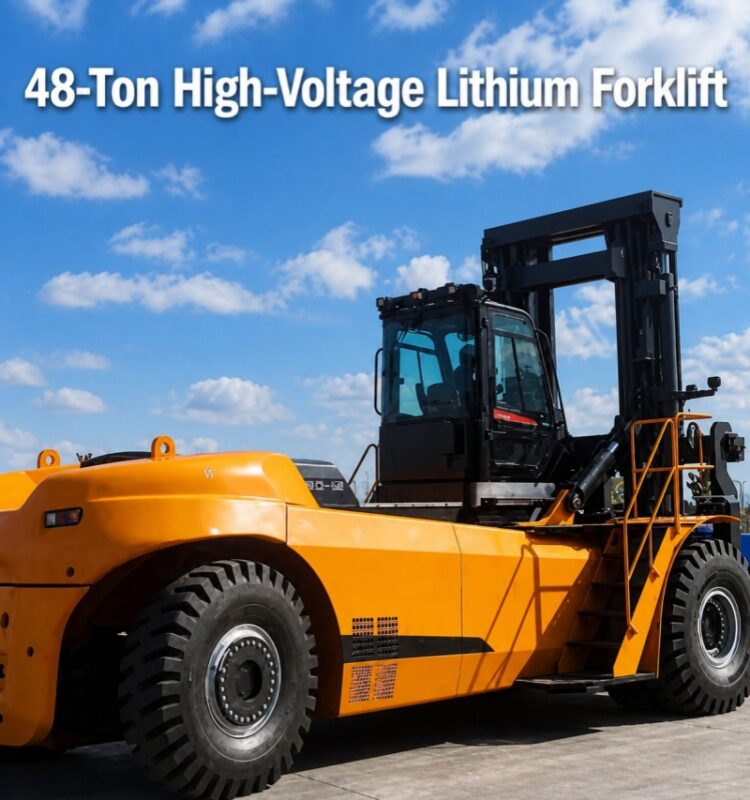
Table of Contents
A 48 ton high voltage lithium forklift is not just a bigger battery story. It is a sign that electric forklifts are moving deeper into jobs that were long treated as diesel territory. Once a truck reaches this size class, buyers stop asking only about emissions or charging. They start asking harder questions: whether the voltage platform is mature, whether the truck can hold a full shift, and whether the electric layout can actually compete in heavy-duty handling.
That is why this reported delivery matters. The useful part is not the excitement around the launch. It is the technical direction behind it.
Why a 48 Ton High Voltage Lithium Forklift Matters
At smaller capacities, electric forklifts are already normal in many warehouses. At 48 tons, the conversation changes. Trucks in this bracket work in steel yards, heavy equipment plants, ports, large-component handling, and other applications where downtime, torque delivery, and thermal stability matter more than headline marketing.
So when a heavy-duty lithium truck is delivered into actual use, it suggests that the industry is pushing beyond pilot language and into harder operating ground. That does not mean every site is ready to switch. It does mean the category is becoming more serious.
The Real Technical Shift Is the High-Voltage Platform
The most relevant number in the article is not 48 tons by itself. It is the reported jump from a conventional 80V electric layout to a 309V platform. That matters because heavy electric forklifts need more than battery capacity. They need a power architecture that can support stronger performance without turning heat loss, current load, and cabling stress into a maintenance penalty.
In plain terms, a high-voltage electric forklift platform gives engineers more room to manage power delivery efficiently. That becomes more important as truck size rises. It also fits the wider direction shown in Hangcha’s official XH high-voltage lithium range, which positions heavy-duty electric forklifts as a practical alternative to internal combustion models rather than a niche add-on.
Charging Time and Runtime Are Only Useful When They Match the Job
The article claims a charging time of about 1.6 hours and a full working day of runtime. Those are strong numbers if they hold under the real duty cycle. For buyers, though, the better question is not whether the truck can finish one ideal shift. The better question is how it performs under actual load, travel distance, attachment use, ambient temperature, and charging-window pressure.
That is where heavy-duty battery planning starts to matter. A large truck can look excellent on paper and still become awkward if the site has weak charging discipline or unpredictable peak demand. Readers working through those battery-side decisions can compare their application needs with Baufar’s forklift lithium battery guide before treating capacity and charge time as settled answers.
Performance Claims Need a Practical Reading
The article also repeats claims of more than 30% higher performance and roughly 20% lower energy consumption than traditional electric forklifts. Those figures may point in the right direction, but they still need context. Heavy-load acceleration, hydraulic demand, slope work, shift length, and operator habits can all reshape the outcome.
So the sensible reading is this: the truck points to a meaningful design step, but buyers should still ask for application-specific data. In heavy equipment, a broad percentage claim is never the same thing as a purchasing answer.
What Buyers Should Actually Watch Next
If this class of heavy duty lithium forklift keeps moving from announcement to site use, a few metrics will matter more than the headline itself.
- Voltage architecture and thermal control under continuous heavy load.
- Real charging time between shifts, not only ideal lab timing.
- Battery access, service procedures, and electrical safety isolation.
- Runtime consistency across hot weather, uneven cycles, and long travel routes.
- Total operating cost compared with diesel in the same application.
That is the real takeaway. The arrival of a 48 ton high voltage lithium forklift does not prove that every heavy fleet should switch tomorrow. It does show that the electric side is moving into a class of work that used to feel out of reach. For buyers, that makes this less of a novelty story and more of a technology checkpoint.
Featured Forklift LiFePo4 Battery
48V Forklift Battery
51.2v 460Ah Forklift Lithium Battery For BT RR-M6
48V Forklift Battery
Nichiyu FB25PN-75 Forklift Lifepo4 Battery 48V 460Ah
80V Forklift Battery
Forklift Lithium-ion Battery 80v 404Ah for Toyota 7FB30-7FBJ35
48V Forklift Battery
Forklift Lithium Battery 51.2v 404Ah for Still FM-X
48V Forklift Battery
48V 519Ah Lifepo4 Lithium Battery for Heli CPD20/25-GB2/GD Forklift
80V Forklift Battery
80V 404Ah Lifepo4 Lithium Battery for CPD30/35-G1/G3 Forklift
80V Forklift Battery
80V 560AH Lifepo4 Lithium Battery for HELI CPD35-GD2
80V Forklift Battery
80V 600Ah LiFePO4 Lithium Battery for NICHIYU FBC25/30P Forklift