

 Forklift LiFePo4 Battery
 Golf Cart LiFePo4 Battery
 Battery Charger
Table of Contents
Electric forklift automation software is becoming a serious buying topic for global warehouses. The conversation is no longer only about truck capacity, mast height or travel speed. Instead, buyers now ask how forklifts connect with WMS, ERP, AGV fleets, conveyors, storage systems and charging infrastructure.
Recent product signals from major forklift brands show the same direction. For example, compact trucks serve tight spaces. Electric forklift factories are expanding closer to end markets. Meanwhile, automation platforms are turning lift trucks into part of a wider logistics network.
From Individual Trucks To Connected Logistics
Traditional forklift procurement often starts with a simple question: which truck can move this pallet? That question still matters. However, larger warehouse operators now ask a second question: how will the truck fit into the whole material flow?
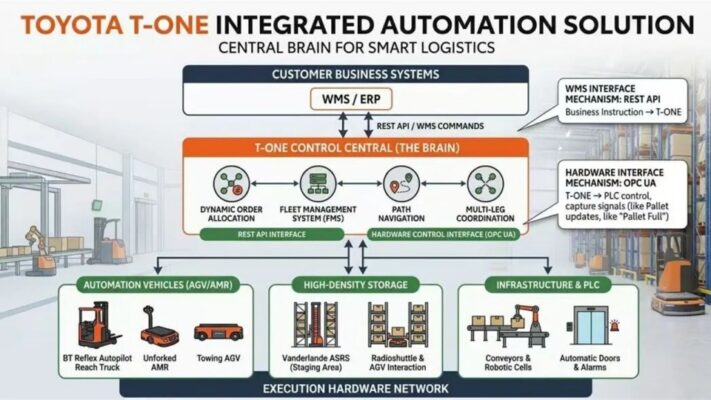
Toyota’s T-ONE concept is a useful example. In this model, the framework links business systems, control software, autonomous vehicles, high-density storage and site infrastructure. As a result, the forklift becomes one node in a coordinated warehouse system.
Why T-ONE Matters To Global Buyers
The T-ONE diagram from the source material shows a central control layer between customer systems and execution hardware. It includes WMS/ERP input, dynamic order allocation, fleet management, path navigation and multi-leg coordination.
For buyers, this matters because software changes the equipment decision. A warehouse automation forklift fleet needs predictable vehicles, reliable data and stable charging behavior. Therefore, the battery system must support the software plan, not just the truck body.
Electric Forklift Automation Software Interfaces Are Part Of Selection
In a connected fleet, system interfaces become part of procurement. For instance, the source diagram highlights REST API communication with WMS commands and OPC UA communication with hardware control systems. That is a different buying conversation from a standard manual forklift order.
For international buyers, the key question is practical. Can the forklift fleet receive jobs from the warehouse system? Can it coordinate routes with other vehicles? Also, can chargers, doors, conveyors and PLC signals work with the same plan?
API Integration Can Reduce Custom Engineering
A REST API approach can reduce the need for heavy custom integration when the WMS supplier can issue structured requests. However, the project still needs careful mapping. In particular, order priority, pallet status, route conflicts and charging breaks must all have clear logic.
OPC UA or similar industrial communication can connect automation software with facility hardware. That matters when forklifts need doors, conveyors, lifts, robotic cells or staging areas to respond at the right time.
Automation Raises The Standard For Lithium Batteries
A manual forklift fleet can absorb some variation. By contrast, an automated fleet has less tolerance for surprises. If the battery does not support predictable runtime, clear SOC data and planned charging, the software cannot keep the material flow stable.
This is where a lithium ion forklift battery becomes more than an energy box. The battery must provide useful data, safe current delivery and charging behavior that fits the dispatch logic.
Charging Windows Need To Match The Task Plan
Automation software can schedule vehicles, but it cannot create energy from nowhere. Therefore, every automated project should define charging windows before fleet rollout. Break-time charging, battery swapping, standby charging and dedicated charging zones each create different equipment needs.
A high-use AGV or automated reach truck may need a stronger lithium traction battery than a lighter manual truck. Capacity, C-rate, BMS limits, connector design and charger communication all deserve review.
Compact Trucks Still Matter In Automation
The source article also points to compact short-fork handling equipment for tight spaces. This is not a small detail. Many overseas warehouses operate in older buildings, narrow rooms, retail back-of-house areas or mezzanine zones where standard pallet handling equipment is too large.
In these locations, shorter forks and tighter turning behavior can reduce damage risk. However, compact equipment still needs the right battery and charger. Otherwise, a smaller truck with poor energy planning can become a weak link in an efficient site.
Safety Systems Are Becoming More Visible
Automation does not remove safety planning. It makes safety design more structured. The source material mentions mobile personnel protection in a German Toyota facility, and this aligns with a broader trend: electric and automated fleets need better detection, zoning and traffic control.
For forklift buyers, safety should connect to the power system too. Battery restraints, cable routing, charging areas, connectors and emergency procedures all affect daily risk. OSHA also emphasizes that powered industrial trucks should stay in safe operating condition through inspection and proper operation.
What This Means For Battery Buyers
Electric forklift automation software changes how buyers should evaluate power systems. A replacement battery for a manual truck may only need the correct size, voltage and connector. By contrast, an automated or semi-automated fleet needs a cleaner energy strategy.
- Confirm voltage, tray size, weight and connector compatibility.
- Define runtime by task, route and dispatch cycle.
- Check whether SOC and fault data can support fleet decisions.
- Match charger output to planned idle windows.
- Review BMS current limits for high-use automated routes.
- Confirm communication needs between truck, charger and control software.
- Plan safe charging locations before vehicles arrive.
A custom forklift lithium battery can help when standard packs do not match the vehicle tray, charging strategy or communication requirements. In many automation projects, that fit matters as much as nominal capacity.
The Buyer Takeaway
Forklift automation is moving from a special project into a normal strategic option for global warehouses. Toyota’s T-ONE concept shows one direction: connect business systems, fleet control, vehicles, storage and facility hardware into one operating model.
For buyers, the battery decision should move with that trend. The right electric forklift battery must support uptime, software coordination, safe charging and field service. When the truck, software and lithium power system work together, automation has a much better chance of delivering real productivity.
Featured Forklift LiFePo4 Battery
48V Forklift Battery
51.2v 460Ah Forklift Lithium Battery For BT RR-M6
48V Forklift Battery
Nichiyu FB25PN-75 Forklift Lifepo4 Battery 48V 460Ah
80V Forklift Battery
Forklift Lithium-ion Battery 80v 404Ah for Toyota 7FB30-7FBJ35
48V Forklift Battery
Forklift Lithium Battery 51.2v 404Ah for Still FM-X
48V Forklift Battery
48V 519Ah Lifepo4 Lithium Battery for Heli CPD20/25-GB2/GD Forklift
80V Forklift Battery
80V 404Ah Lifepo4 Lithium Battery for CPD30/35-G1/G3 Forklift
80V Forklift Battery
80V 560AH Lifepo4 Lithium Battery for HELI CPD35-GD2
80V Forklift Battery
80V 600Ah LiFePO4 Lithium Battery for NICHIYU FBC25/30P Forklift