


 Forklift LiFePo4 Battery
 Golf Cart LiFePo4 Battery
 Battery Charger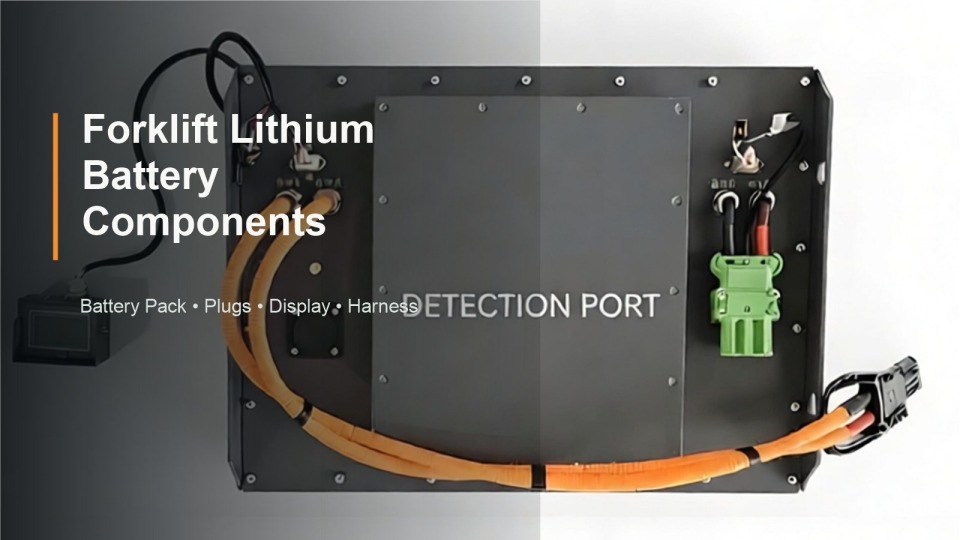
Table of Contents
A complete forklift lithium battery system includes the pack, power connectors, charging plug, display and service interfaces.
A forklift lithium battery components guide helps buyers look beyond the battery box. The pack matters, of course. However, plugs, cables, display wiring and service ports decide whether the system is easy to install, inspect and use every day.
For overseas forklift buyers, these details are practical. For example, a battery that fits the tray but uses the wrong connector, display location or charging interface can delay a fleet conversion. Therefore, a component check should happen before shipment, not after the battery arrives.
What Comes With A Forklift Lithium Battery Pack?
A typical forklift lithium battery pack is built around a metal battery enclosure. Inside the enclosure, lithium cells, battery management electronics and internal protection structures support the truck’s power demand.
In this product layout, the complete system includes the following parts:
- Battery pack with a metal enclosure.
- Discharge plug for connection to the forklift socket.
- Discharge cables, usually marked as P+ and P-.
- Charging plug for connection to the charger.
- Display and harness for SOC and voltage information.
- Detection port plus reserved switch and CAN interface for inspection and service use.
Battery Pack
First, the battery pack is the main energy storage unit. Its enclosure protects the cells and gives the pack a shape that can match the forklift battery compartment. For a replacement project, buyers should confirm tray size, mounting points, cable exit direction and counterweight requirements.
Capacity should also match the real duty cycle. A light warehouse truck may need a different lithium ion traction battery than a high-use truck working long shifts or frequent opportunity charging.
Discharge Plug And Power Cables
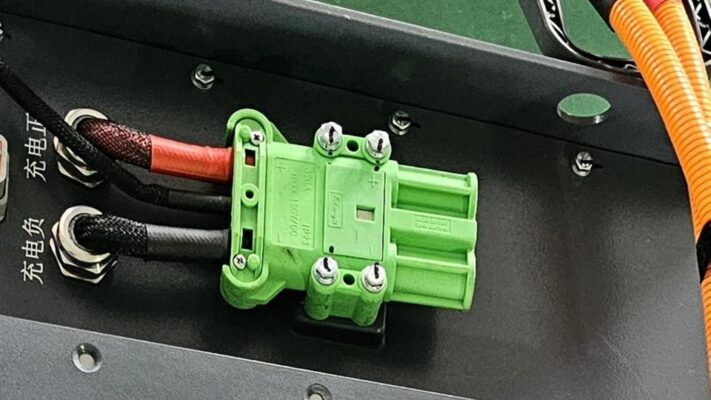
Next, the discharge plug connects the battery to the forklift’s power socket. This connection must handle the truck’s current demand and stay secure during vibration, travel and lifting work.
Why Connector Matching Matters
An electric forklift battery connector is not just a plug shape. Instead, it affects installation speed, service safety and downtime risk. Buyers should confirm connector type, polarity, cable length, cable protection and whether the connector locks correctly in the forklift socket.
High-current discharge cables often use protective conduit. That routing helps protect the cable from abrasion and contact with sharp edges. Also, clear P+ and P- identification helps technicians avoid wiring mistakes during installation.
Charging Plug And Charger Compatibility
Then, the charging plug connects the battery to the charger. In this product layout, the charging connector is separate from the discharge connector. As a result, the operating process can stay cleaner because the truck connection and charger connection each have a clear role.
Before placing an order, buyers should confirm charger voltage, charging current, connector type and charger communication. A battery specification review should include Ah, voltage, Wh, C-rate, SOC and SOH, not only the model name.
Opportunity Charging Needs Planning
Many lithium forklift fleets use opportunity charging during breaks. However, the charging plug, charger output and BMS settings must support that plan. If the site uses shared chargers, the connector and software settings should be checked before rollout.
Display And Harness
The display gives operators and maintenance teams a quick view of battery status. In addition, real-time SOC and voltage information helps teams decide when to charge and when to investigate abnormal behavior.

Mounting The Display
The display should be mounted where the operator or maintenance team can read it without interfering with controls, visibility or safe operation. During conversion work, the harness route should avoid pinch points, hot surfaces and moving parts.
For distributors, this is a small detail with a big service impact. As a result, a neat harness path can reduce warranty questions and make future inspection easier.
Detection Port, Reserved Switch And CAN Interface
Finally, the detection port and reserved CAN interface are service features. In normal delivery, the end user does not need to operate the detection port because it is for inspection and repair use.
This distinction matters. Operators need clear instructions for daily use. Service teams need access for diagnostics, settings and fault checks. A good custom forklift lithium battery should separate those two needs.
Three-Step Setup Flow
The source product uses a simple plug-and-play setup concept. In practice, trained personnel should still check fit, polarity, cable protection and charger compatibility before putting the forklift into service.
Step 1: Plug In The Discharge Connector
Connect and lock the discharge plug into the forklift socket. Then check that the cable path is secure and does not rub against sharp edges.
Step 2: Mount The Display
Route the display harness into the cab and mount the display in a readable position. Next, confirm that the screen shows SOC and voltage normally.
Step 3: Charge When Needed
Connect the charging plug to the charger when charging is required. Also, confirm that the charger and battery communicate correctly if the system uses communication-based charging control.
Buyer Checklist Before Shipment
- Confirm battery tray dimensions and enclosure size.
- Check total weight and counterweight requirements.
- Confirm discharge connector type, polarity and cable length.
- Confirm charging connector type and charger compatibility.
- Ask where the display will be mounted.
- Review harness routing before installation.
- Clarify whether CAN communication is required.
- Separate operator instructions from service-only ports.
- Request photos or drawings before shipment for fleet conversions.
Why A Forklift Lithium Battery Components Guide Reduces Fleet Risk
A lithium battery conversion can fail on small details. A cable that exits in the wrong direction, a charger plug that does not match the site or a display that cannot be mounted neatly can slow the whole project.
This is why a forklift lithium battery components guide should be part of the buying process. When the battery pack, discharge plug, charging plug, display and service interface are confirmed in advance, the fleet gets a cleaner installation and fewer surprises after delivery.
Featured Forklift LiFePo4 Battery
48V Forklift Battery
51.2v 460Ah Forklift Lithium Battery For BT RR-M6
48V Forklift Battery
Nichiyu FB25PN-75 Forklift Lifepo4 Battery 48V 460Ah
80V Forklift Battery
Forklift Lithium-ion Battery 80v 404Ah for Toyota 7FB30-7FBJ35
48V Forklift Battery
Forklift Lithium Battery 51.2v 404Ah for Still FM-X
48V Forklift Battery
48V 519Ah Lifepo4 Lithium Battery for Heli CPD20/25-GB2/GD Forklift
80V Forklift Battery
80V 404Ah Lifepo4 Lithium Battery for CPD30/35-G1/G3 Forklift
80V Forklift Battery
80V 560AH Lifepo4 Lithium Battery for HELI CPD35-GD2
80V Forklift Battery
80V 600Ah LiFePO4 Lithium Battery for NICHIYU FBC25/30P Forklift