

 Forklift LiFePo4 Battery
 Golf Cart LiFePo4 Battery
 Battery Charger
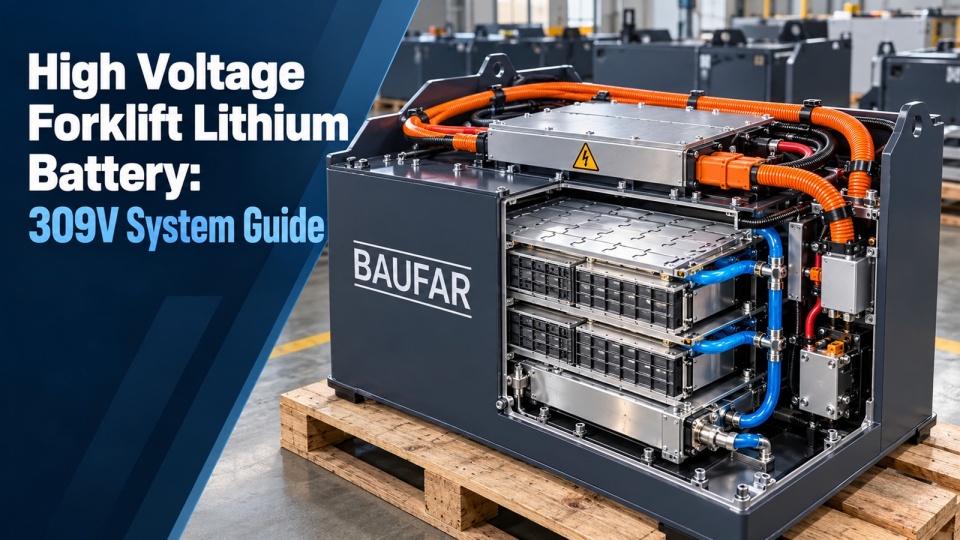
Table of Contents
A high voltage forklift lithium battery is more than a larger version of an 80V traction pack. A 309V system changes current levels, charger design, insulation requirements, thermal management and the way the battery communicates with the truck. For buyers, the useful question is not whether high voltage sounds more powerful. It is whether the complete battery system has been engineered for the truck, duty cycle and charging infrastructure.
What Changes in a High Voltage Forklift Lithium Battery?
Electrical power is the product of voltage and current. For the same power demand, increasing system voltage allows current to fall. This matters because resistive heat rises with the square of current. Lower current can give engineers more room to manage conductor size, connector load and heat loss in a high-power traction system.
An idealized example makes the difference clear. Delivering 100kW at 80V would require about 1,250A, while 100kW at 309V would require about 324A before efficiency losses are considered. The actual truck values depend on motor, inverter, hydraulic demand and control limits, but the relationship explains why higher-voltage platforms appear in heavy-duty electric equipment.
Higher voltage does not automatically create longer runtime. Runtime depends mainly on usable energy in kWh and the real duty cycle. Voltage helps shape how power is delivered; energy capacity determines how much work the pack can support before charging.
Reading a 309V, 96Ah Battery Specification
The example battery is rated at 309.12V and 96Ah. Multiplying voltage by ampere-hours gives approximately 29.7kWh of nominal energy. Usable energy will be lower because the BMS reserves upper and lower state-of-charge margins and may apply limits for temperature, current or battery health.
This is why Ah alone is not enough for a high-voltage pack. A 96Ah figure can look small beside a conventional forklift battery, but the much higher voltage changes the total energy. Buyers who need a refresher can review BAUFAR’s guide to voltage, Ah, kWh, C-rate, SOC and SOH.
Nominal voltage is only the starting point
A complete specification should also show the minimum and maximum pack voltage, continuous and peak discharge current, continuous and peak power, usable energy, cell chemistry and allowed SOC window. The inverter and motor controller must accept the entire operating-voltage range, not only the nominal figure printed on the battery.
0.5C and 1C Fast Charging Explained
The source system lists standard 0.5C charging and optional 1C charging. For a 96Ah battery, 0.5C corresponds to roughly 48A and 1C to roughly 96A. At the nominal 309.12V pack voltage, those figures represent about 14.8kW and 29.7kW of DC charging power. Actual charger power and charge time vary as pack voltage changes, the current tapers near the target SOC, and cooling or other auxiliary systems consume energy.
A 1C rating therefore does not promise a full charge in exactly one hour under every condition. It describes a current relative to battery capacity. A 30-minute charging stop is usually an opportunity charge between two SOC levels, not a guaranteed empty-to-full cycle.
The charger is part of the battery system
A high-voltage charger must match the pack’s voltage window, current limit, communication protocol, connector and insulation design. The site must also provide the required AC input power. Fleet buyers should calculate simultaneous charging demand instead of checking one charger in isolation.
Frequent fast charging should be included in the battery validation plan. Cell temperature, SOC limits, charge taper, cooling capacity and expected cycle life must be reviewed together. A charger that can supply 1C is useful only when the cells, busbars, contactors, cables, cooling loop and BMS are designed to accept it.
Why Liquid Cooling Matters at High Power
Heavy discharge and fast charging both create heat. A liquid-cooled forklift battery can move that heat from cell modules to a controlled cooling circuit more evenly than relying on natural airflow alone. A well-designed system may include cooling plates, a pump, coolant lines, a heat exchanger or compressor circuit, temperature sensors and BMS control.
The source layout describes three thermal functions:
- Temperature equalization: coolant circulation reduces temperature differences between cell areas.
- Cooling: the system removes heat during demanding discharge and fast charging.
- Heating: an optional coolant heater prepares the battery for operation or charging in low temperatures.
Thermal management does not make every temperature claim automatically valid. Buyers should ask for defined charge and discharge limits, derating behavior, test conditions and fault responses. The external ambient range and the permitted cell-temperature range are different specifications.
High Voltage Safety Requires a Complete Architecture
A 309V battery cannot be treated like a basic low-voltage replacement pack. The project should define high-voltage isolation, service procedures and fault handling before installation. Depending on the system design and applicable standards, the architecture may include:
- Main positive and negative contactors.
- A precharge circuit to control inrush current.
- Pack fuses and correctly rated disconnect devices.
- Insulation monitoring and high-voltage interlock functions.
- Orange high-voltage cables, touch-safe connectors and mechanical protection.
- BMS monitoring for cell voltage, temperature, current, SOC and fault status.
- CAN communication with the charger, inverter and vehicle controller.
- Emergency isolation and documented lockout procedures.
An IP rating such as IP67 describes enclosure protection under defined test conditions. It does not replace electrical isolation testing, connector validation, vibration testing or safe service design. BAUFAR’s forklift lithium battery components guide explains why plugs, cables, displays and service interfaces must be confirmed with the pack.
A 309V Pack Is Not a Drop-In 80V Conversion
The motor, inverter, DC/DC converter, charger, wiring, connectors, cooling system and control software must all be compatible with the higher voltage. Battery mass, enclosure mounting and crash or impact protection also need vehicle-level review. Simply replacing an 80V pack with a 309V battery would damage equipment and create a severe safety risk.
This is the key difference between a normal replacement battery and an integrated high-voltage project. The truck and battery must be engineered as one system. BAUFAR’s earlier review of a 48-ton high-voltage lithium forklift explains why voltage architecture, charging time and thermal stability matter more than the headline tonnage.
Buyer Checklist for a High Voltage Forklift Battery
Electrical specification
- Nominal, minimum and maximum pack voltage.
- Nominal and usable kWh.
- Continuous and peak discharge current and duration.
- Continuous and peak power at relevant SOC and temperature levels.
- Charging current, C-rate, voltage window and taper strategy.
Thermal and environmental specification
- Liquid-cooling and heating capacity.
- Allowed cell-temperature range and ambient-temperature range.
- Derating and shutdown thresholds.
- Enclosure rating, corrosion protection and coolant-service requirements.
Integration and safety
- Vehicle, inverter and charger communication protocols.
- Contactor, precharge, fuse, isolation-monitoring and interlock design.
- Connector voltage and current ratings.
- Emergency response, service disconnect and technician training.
- Validation reports, transport documentation and applicable market certifications.
A custom forklift lithium battery should be approved from system data, not from voltage and Ah alone. The most useful buyer package includes the truck power demand, hydraulic duty, shift energy, charging windows, ambient conditions and vehicle communication requirements.
What the 309V Example Really Demonstrates
The important development is not one runtime or charging headline. It is the move toward an integrated battery architecture that combines higher voltage, managed fast charging, liquid thermal control and vehicle communication. Those elements give designers more control over current, heat and power delivery in demanding forklift applications.
From BAUFAR’s battery-engineering perspective, high voltage adds capability and responsibility at the same time. The correct solution starts with power and energy calculations, then proves thermal performance, charging compatibility, electrical protection and vehicle integration. When those pieces are validated together, a high voltage forklift lithium battery becomes an engineered traction system rather than a large battery box.
Featured Forklift LiFePo4 Battery
48V Forklift Battery
51.2v 460Ah Forklift Lithium Battery For BT RR-M6
48V Forklift Battery
Nichiyu FB25PN-75 Forklift Lifepo4 Battery 48V 460Ah
80V Forklift Battery
Forklift Lithium-ion Battery 80v 404Ah for Toyota 7FB30-7FBJ35
48V Forklift Battery
Forklift Lithium Battery 51.2v 404Ah for Still FM-X
48V Forklift Battery
48V 519Ah Lifepo4 Lithium Battery for Heli CPD20/25-GB2/GD Forklift
80V Forklift Battery
80V 404Ah Lifepo4 Lithium Battery for CPD30/35-G1/G3 Forklift
80V Forklift Battery
80V 560AH Lifepo4 Lithium Battery for HELI CPD35-GD2
80V Forklift Battery
80V 600Ah LiFePO4 Lithium Battery for NICHIYU FBC25/30P Forklift