


 Forklift LiFePo4 Battery
 Golf Cart LiFePo4 Battery
 Battery Charger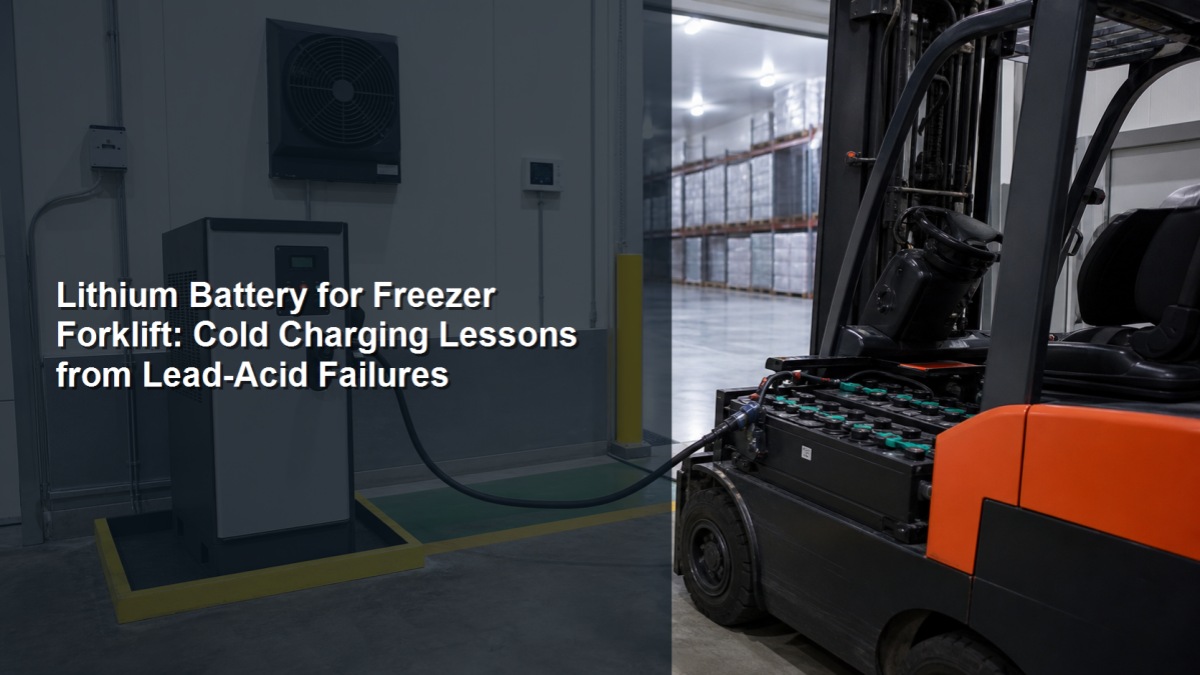
Table of Contents
Cold weather exposes a problem that many forklift fleets overlook. The source WeChat article warns that many factories charge lead-acid forklift batteries at the wrong time. As a result, batteries lose runtime, develop voltage imbalance, and reach replacement earlier than expected.
This topic also matters for buyers evaluating a lithium battery for freezer forklift use. Cold storage warehouses need reliable power. However, low temperature changes how batteries accept charge, how chargers behave, and how managers should plan daily charging.
Why Cold Charging Became an Industry Maintenance Issue
The source article focuses on flooded lead-acid traction batteries. It says many operators plug in the charger as soon as a shift ends. Others charge first thing in the morning after the forklift stayed overnight in a cold area.
At first, this looks efficient. However, the battery may be too cold to accept charge well. The charger can show a full status because surface voltage rises. Still, the deeper battery material may remain undercharged.
Over time, this habit can encourage sulfation. It can also increase cell imbalance. Therefore, a battery may appear fully charged but lose voltage quickly during work.
What the Source Article Says About Timing
The article gives two common winter examples. First, a forklift may sit outside or in a low-temperature workshop overnight. In that case, operators should not charge immediately in the morning. Instead, the truck should run lightly for a short time. This can help the battery warm above the lowest temperature zone before charging.
Second, a forklift may finish a hard shift. In winter, the battery may still be cold after outdoor use. However, after heavy continuous work, it may also be too hot. Both cases need caution. The article recommends letting the battery temperature stabilize before charging.
The exact timing depends on the battery type, temperature, charger, and site rules. However, the main lesson is clear. Charging should follow battery condition, not only the clock.
Lead-Acid Lessons for Cold Storage Forklift Buyers
Lead-acid batteries can work in cold environments. However, they need disciplined maintenance. Battery University notes that charging at low and high temperatures needs special care. It also explains that lead-acid charging voltage should adjust with temperature.
This helps explain why old chargers create problems in winter. A charger with no temperature compensation may undercharge or overcharge the battery. As a result, the fleet may see shorter runtime, more watering, faster sulfation, and more frequent battery replacement.
For facilities still using lead-acid forklift truck batteries, managers should check battery temperature, electrolyte condition, water level, charger settings, and equalization records. In addition, they should keep charging areas ventilated and controlled.
Why Lithium Batteries Need a Different Cold-Storage Review
A lithium battery for freezer forklift can reduce many lead-acid maintenance tasks. For example, lithium batteries do not need watering. They can also support opportunity charging when the battery, charger, and BMS allow it.
However, lithium is not a magic shortcut in cold storage. Standard lithium-ion cells require strict low-temperature charging protection. Battery University notes that lithium-ion charging below freezing needs special care. Therefore, freezer applications need the right battery design, not just a lithium label.
Key questions before choosing lithium for freezer forklifts
- Operating temperature: What is the normal freezer or cold-room temperature?
- Charging temperature: Will charging happen inside the cold room or in a warmer charging area?
- BMS protection: Does the BMS block unsafe low-temperature charging?
- Heating system: Does the battery need internal heating for charging or operation?
- Charging window: Can the fleet use short charging breaks without harming the battery?
- Voltage platform: Does the truck need 24V, 36V, 48V, 80V, or another voltage?
- Charger match: Does the charger communicate with the battery and follow the correct charging profile?
- Safety documents: Can the supplier provide installation, use, storage, and emergency guidance?
Charging Safety Still Matters in Winter
The source article also highlights ventilation. This point matters, especially for lead-acid batteries. OSHA guidance says electric forklift charging areas need proper controls. These include designated charging areas, fire protection, water for electrolyte incidents, and adequate ventilation for hydrogen gas.
Winter can make this harder. Doors and windows often stay closed. As a result, hydrogen can accumulate if a facility charges lead-acid batteries in a poorly ventilated area. Therefore, cold-weather charging plans must include air movement, cable control, charger protection, and trained personnel.
When Equalization Helps and When Replacement Is Safer
The source article says long-term poor charging can create cell voltage imbalance. In mild cases, equalization and smart balancing may help lead-acid batteries recover some consistency. However, this only works when the battery still has recoverable condition.
In severe cases, managers should not chase endless repair. Swollen batteries, broken cells, serious plate softening, or repeated fast voltage drop can create safety and productivity risks. At that point, replacement may be the better decision.
For buyers comparing replacement options, Baufar’s Forklift Battery Terms Explained article explains Ah, V, Wh, C-rate, SOC, and SOH. These values help managers compare battery health and replacement timing more clearly.
How Baufar Battery Fits Cold Storage Applications
Cold storage fleets need batteries that match the real worksite. A lithium battery for freezer forklift should match the truck voltage, load profile, charging temperature, connector layout, and daily duty cycle. It should also include BMS protection that fits low-temperature use.
Baufar provides voltage-specific forklift lithium options, including 24V forklift lithium batteries, 48V forklift lithium batteries, and 80V forklift lithium batteries. For special freezer conditions, buyers can also review custom forklift lithium batteries.
In addition, Baufar’s Electric Forklift Battery Technology article explains why the battery should be part of a wider system. That system includes charger choice, charging schedule, BMS data, service planning, and total cost.
Industry Takeaway: Temperature Should Drive the Charging Plan
The WeChat source article gives a useful reminder for winter operations. Battery charging should not run only by habit. Instead, managers should consider battery temperature, charger capability, ventilation, and actual duty cycle.
For lead-acid fleets, this can reduce sulfation and early failure. For lithium fleets, it can prevent unsafe charging and protect battery life. For cold storage buyers, the best result comes from matching the battery system to the freezer environment from the start.
That is why the decision is not simply lead-acid versus lithium. The better question is whether the battery, charger, BMS, and charging area can work together in low-temperature operations. For a lithium battery for freezer forklift, that system-level review is essential.
# References / Sources
– OSHA Powered Industrial Trucks eTool, Electric Power Sources and Battery Charging: https://www.osha.gov/etools/powered-industrial-trucks/types-fundamentals/power-sources/electrical
Featured Forklift LiFePo4 Battery
48V Forklift Battery
51.2v 460Ah Forklift Lithium Battery For BT RR-M6
48V Forklift Battery
Nichiyu FB25PN-75 Forklift Lifepo4 Battery 48V 460Ah
80V Forklift Battery
Forklift Lithium-ion Battery 80v 404Ah for Toyota 7FB30-7FBJ35
48V Forklift Battery
Forklift Lithium Battery 51.2v 404Ah for Still FM-X
48V Forklift Battery
48V 519Ah Lifepo4 Lithium Battery for Heli CPD20/25-GB2/GD Forklift
80V Forklift Battery
80V 404Ah Lifepo4 Lithium Battery for CPD30/35-G1/G3 Forklift
80V Forklift Battery
80V 560AH Lifepo4 Lithium Battery for HELI CPD35-GD2
80V Forklift Battery
80V 600Ah LiFePO4 Lithium Battery for NICHIYU FBC25/30P Forklift