


 Forklift LiFePo4 Battery
 Golf Cart LiFePo4 Battery
 Battery Charger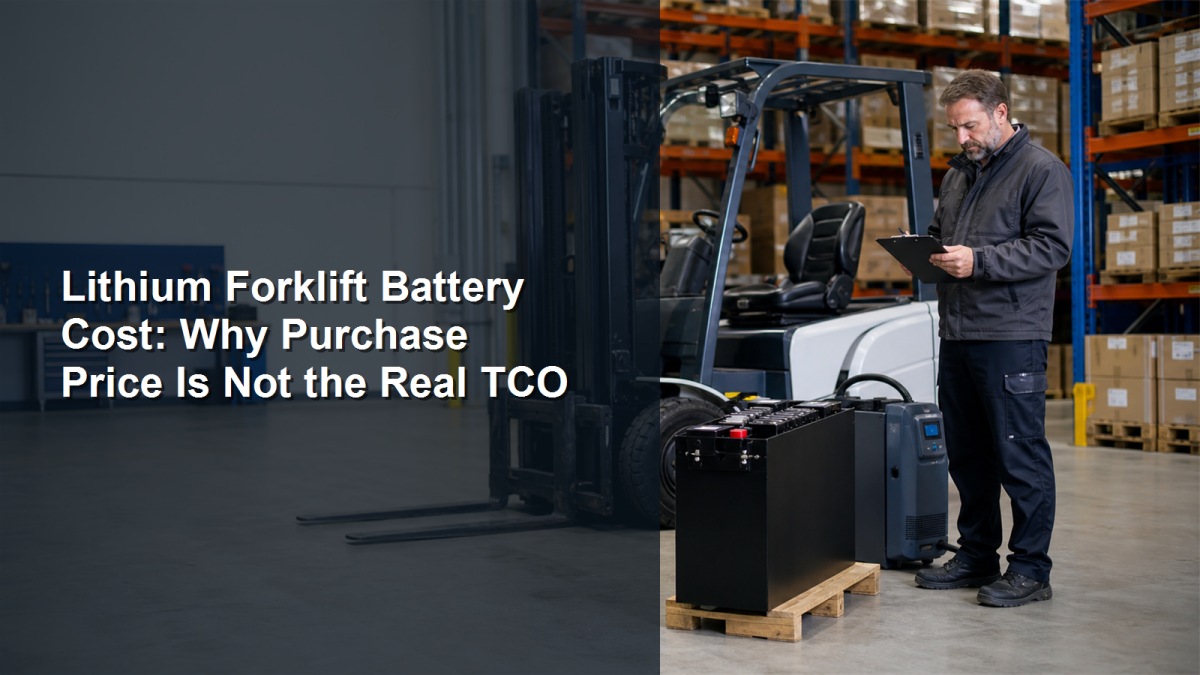
Table of Contents
Lithium forklift battery cost is often judged by the first quote. However, that is only one part of the buying decision. A recent industry article makes a useful point for fleet managers: the cheapest battery at purchase may not be the cheapest battery to own.
Forklift truck batteries influence more than the truck’s power source. They affect runtime, charging labor, battery-room space, maintenance work, safety exposure, spare battery inventory, and replacement timing. As a result, buyers should compare total cost of ownership before choosing between lithium and lead-acid batteries.
Why Battery Price Can Mislead Fleet Buyers
Lead-acid batteries usually cost less at the start. This is why many buyers still see them as the budget option. However, the real cost includes every expense created during battery ownership.
That means buyers should include maintenance labor, water filling, cleaning, equalization, charging-room management, battery swapping, downtime, and replacement frequency. Once these items enter the model, the comparison can change.
Service Life Changes the Cost Equation
Service life is one of the first TCO factors to review. A battery that needs replacement sooner can make a low purchase price less attractive. In contrast, a battery with a longer practical service life can spread its cost over more operating years.
This matters most in busy warehouses. A low-use facility may focus on initial price. However, a multi-shift fleet should look at how many years the battery can support daily work before replacement.
Therefore, buyers should calculate battery cost across a realistic planning period. Five to ten years is often more useful than a single purchase cycle.
Charging Time and Battery Swapping Add Hidden Costs
The source article highlights charging time as a major cost factor. Lead-acid batteries often require long charging periods. They may also need cooling time before the next use.
In multi-shift operations, this can lead to spare battery inventory. It can also require battery exchange equipment and extra labor. As a result, the fleet pays for more than one battery per truck.
Lithium ion forklift battery systems can support simpler charging routines in many applications. For example, some fleets use charging breaks during shifts. However, buyers still need the right charger, connector, BMS settings, and operating rules.
Maintenance Labor Often Decides the Real Cost
Lead-acid forklift batteries need routine care. Typical tasks include watering, cleaning, acid neutralization, inspection, equalization charging, and spill control. These tasks require training, PPE, and supervisor attention.
Lithium forklift batteries reduce many of these tasks. For example, they do not require watering. They also avoid routine acid handling during normal operation. Therefore, maintenance teams can spend less time on battery-room work.
Still, lithium systems need inspection. Teams should check cables, connectors, charger status, BMS alerts, mounting, and documentation. Good maintenance does not disappear. It becomes more focused on data and system checks.
Safety and Downtime Also Affect ROI
Safety belongs inside the TCO review. Lead-acid batteries can involve acid exposure, hydrogen gas, heavy battery handling, and spill response. These issues can create downtime and injury risk when controls are weak.
OSHA guidance treats battery charging and powered industrial truck operation as controlled workplace activities. Therefore, charging-station design, operator training, PPE, ventilation, and inspection routines all affect the real cost of a battery system.
For buyers, the key is simple. Do not treat safety as a separate topic. Safety, labor, downtime, and battery performance should appear in the same ROI review.
What Buyers Should Ask Before Choosing a Battery
- How many hours does each forklift run per day?
- Does the fleet run one shift, two shifts, or continuous operation?
- How many spare batteries does the current system require?
- How much time does the team spend watering, cleaning, and swapping batteries?
- Does the charger match the battery chemistry and voltage?
- What is the expected replacement cycle for each battery option?
- Does the operation need cold storage, outdoor, IP-rated, or explosion-proof options?
- What safety controls does the facility need for charging and maintenance?
- How will the battery supplier support diagnostics, warranty, and replacement planning?
How Baufar Battery Fits the TCO Conversation
Baufar’s forklift lithium battery solutions can help buyers compare battery cost at the system level. Instead of looking only at the battery quote, buyers can review voltage, capacity, charger requirements, BMS features, truck compatibility, and operating environment.
For voltage-specific planning, buyers can review Baufar’s 24V forklift lithium batteries, 48V forklift lithium batteries, and 80V forklift lithium batteries. For non-standard trucks or special operating conditions, custom forklift lithium batteries may offer a better fit.
In addition, Baufar’s Forklift Battery Terms Explained article helps buyers understand Ah, V, Wh, C-rate, SOC, and SOH. These terms are important when comparing lithium forklift battery cost across different suppliers.
Industry Takeaway: TCO Is the Better Buying Metric
The main lesson from the source article is straightforward. Forklift battery price is only one line in the cost model. The real financial picture includes runtime, charging time, labor, maintenance, safety, spare batteries, and replacement frequency.
Lead-acid may still fit some low-use fleets. However, lithium can offer a stronger business case in multi-shift warehouses, high-throughput logistics centers, and operations that value uptime. Therefore, buyers should compare total ownership cost before they decide.
In practical terms, the best battery is not always the cheapest one on day one. It is the battery that delivers reliable power, predictable maintenance, lower downtime, and better ROI across the full service life.
Featured Forklift LiFePo4 Battery
48V Forklift Battery
51.2v 460Ah Forklift Lithium Battery For BT RR-M6
48V Forklift Battery
Nichiyu FB25PN-75 Forklift Lifepo4 Battery 48V 460Ah
80V Forklift Battery
Forklift Lithium-ion Battery 80v 404Ah for Toyota 7FB30-7FBJ35
48V Forklift Battery
Forklift Lithium Battery 51.2v 404Ah for Still FM-X
48V Forklift Battery
48V 519Ah Lifepo4 Lithium Battery for Heli CPD20/25-GB2/GD Forklift
80V Forklift Battery
80V 404Ah Lifepo4 Lithium Battery for CPD30/35-G1/G3 Forklift
80V Forklift Battery
80V 560AH Lifepo4 Lithium Battery for HELI CPD35-GD2
80V Forklift Battery
80V 600Ah LiFePO4 Lithium Battery for NICHIYU FBC25/30P Forklift