

 Forklift LiFePo4 Battery
 Golf Cart LiFePo4 Battery
 Battery Charger
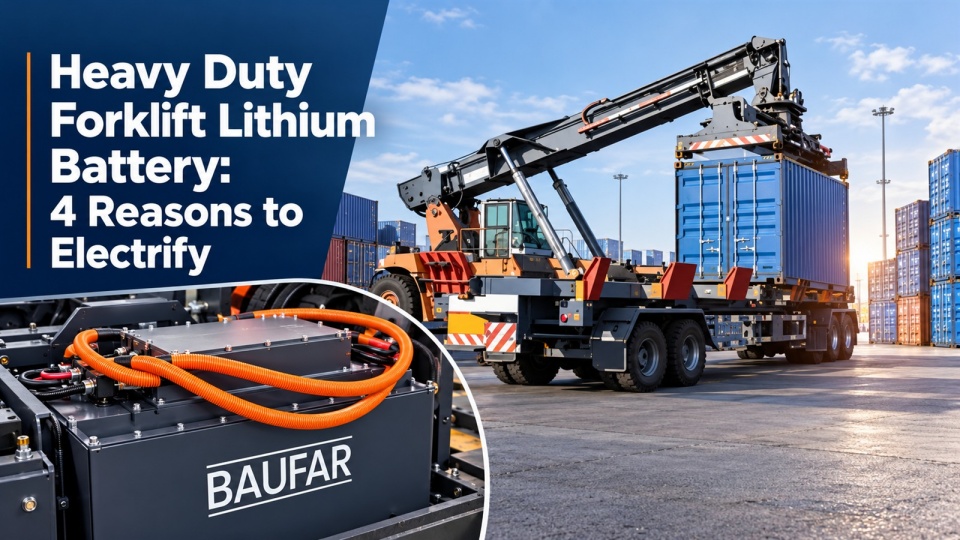
Table of Contents
A heavy duty forklift lithium battery is now a practical option for more ports, factories, timber yards and distribution centers. The decision still needs more than a comparison of diesel fuel and battery capacity. Fleet managers must check load profile, travel distance, gradients, temperature, charging windows and site power before deciding whether electrification will improve the operation.
Four Reasons a Heavy Duty Forklift Lithium Battery Can Make Sense
1. Electric power has moved into demanding applications
High-capacity electric forklifts and container-handling equipment are no longer limited to light indoor work. Current machines use integrated lithium systems for heavier loads and longer operating periods. That makes electrification relevant to applications that once defaulted to diesel or LPG.
However, a heavy rating alone does not prove that a battery will fit the job. The supplier should review peak traction current, lift demand, gradients, attachment use, travel distance and shift schedule. Ambient temperature also matters. Cold conditions can reduce available energy and charging acceptance, while sustained heat may require active thermal management.
At BAUFAR, a custom forklift lithium battery starts with the truck and duty cycle. Voltage, usable energy, discharge current, enclosure size, mass, connector and communication settings must work together.
2. The operator environment can become cleaner and quieter
Battery-electric forklifts have no tailpipe emissions at the point of use. They also remove engine idling and can reduce powertrain noise and vibration. These differences are valuable in enclosed factories, covered loading areas and sites where operators spend long shifts near the equipment.
Lithium charging can also reduce routine battery handling. Opportunity charging during planned breaks may remove the need for battery changes in some operations. That does not remove the need for training. Operators still need clear rules for state of charge, approved chargers, cable inspection and safe connection.
3. Maintenance becomes more predictable
An electric drivetrain avoids many engine service items such as engine oil, filters, spark plugs and belts. A lithium battery also eliminates watering and acid-cleaning tasks associated with flooded lead-acid batteries. For fleets facing tight maintenance capacity, fewer recurring service tasks can support better equipment availability.
“Low maintenance” should not be confused with “no inspection.” Connectors, high-current cables, cooling paths, mounting points and fault records still need scheduled checks. The charger and battery management system must also remain compatible throughout the battery’s service life.
Buyers can review the complete pack, plug, display and interface requirements in our forklift lithium battery components guide.
4. Electrification supports site-emission goals
Replacing an internal-combustion forklift with a battery-electric truck removes tailpipe emissions from the work area. This can support indoor air-quality plans and site-level carbon-reduction targets. Lithium batteries are sealed systems, so they also avoid the routine watering, acid spill and charging-gas concerns associated with flooded lead-acid batteries.
The environmental result is not identical at every site. Electricity generation, battery manufacturing, equipment utilization and end-of-life handling all affect the full footprint. Buyers should describe the benefit precisely: zero tailpipe emissions at the point of use, with lifecycle performance depending on the energy and service system around the truck.
When Lithium Electrification Is Not an Automatic Choice
A lithium ion forklift battery may not be the best immediate option when the site lacks sufficient electrical capacity, the truck has no reliable charging window, or local service support is unavailable. Extreme temperatures also require a battery designed and validated for those conditions. A generic pack should not be installed simply because its nominal voltage matches the truck.
Some fleets may benefit from a phased conversion. High-utilization trucks with predictable routes and scheduled breaks can be assessed first, while units working remotely or continuously without charging access remain on their existing power source until infrastructure improves.
Heavy Duty Forklift Battery Sizing Questions
Truck and load profile
- What are the truck model, rated capacity and system voltage?
- What are the normal and peak load weights?
- How much time is spent lifting, traveling, idling and using attachments?
- Are there ramps, rough surfaces or long outdoor travel routes?
Energy and charging
- How many operating hours are required between charging opportunities?
- Can the fleet charge during breaks, shift changes or planned stops?
- Does the site electrical supply support the required charger power?
- Will simultaneous charging create a peak-demand problem?
Battery integration
- What are the compartment dimensions, mounting points and required battery mass?
- Which connector, cable direction and communication protocol does the truck use?
- Does the application need heating, cooling or a specific enclosure rating?
- How will diagnostics, service and emergency isolation be handled?
Our guide to choosing material handling equipment batteries provides additional questions for capacity, temperature and charging review. For high-voltage or high-capacity projects, the charger should be selected with the battery rather than purchased later as a separate item. BAUFAR also supplies configurable industrial forklift chargers for matched systems.
Build the Business Case from Operating Data
The strongest reason to electrify is not a general claim about lithium. It is a site-specific result. Compare energy use, planned charging time, maintenance labor, consumables, downtime and infrastructure cost over the expected ownership period. Include the cost of chargers, electrical upgrades, training and service support.
BAUFAR uses truck specifications, compartment data and real duty-cycle information to configure an electric forklift battery system around the application. When the load profile and charging plan support it, a heavy duty forklift lithium battery can deliver cleaner operation, simpler routine service and dependable multi-shift energy. When they do not, the design should change before the fleet invests.
Featured Forklift LiFePo4 Battery
48V Forklift Battery
51.2v 460Ah Forklift Lithium Battery For BT RR-M6
48V Forklift Battery
Nichiyu FB25PN-75 Forklift Lifepo4 Battery 48V 460Ah
80V Forklift Battery
Forklift Lithium-ion Battery 80v 404Ah for Toyota 7FB30-7FBJ35
48V Forklift Battery
Forklift Lithium Battery 51.2v 404Ah for Still FM-X
48V Forklift Battery
48V 519Ah Lifepo4 Lithium Battery for Heli CPD20/25-GB2/GD Forklift
80V Forklift Battery
80V 404Ah Lifepo4 Lithium Battery for CPD30/35-G1/G3 Forklift
80V Forklift Battery
80V 560AH Lifepo4 Lithium Battery for HELI CPD35-GD2
80V Forklift Battery
80V 600Ah LiFePO4 Lithium Battery for NICHIYU FBC25/30P Forklift