


 Forklift LiFePo4 Battery
 Golf Cart LiFePo4 Battery
 Battery Charger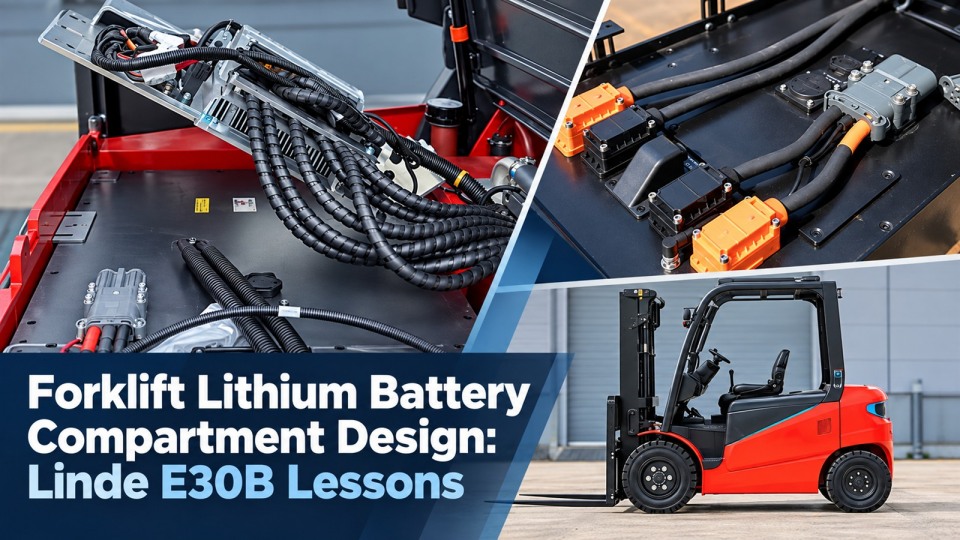
Table of Contents
Forklift lithium battery compartment design is easy to overlook when buyers compare voltage, capacity and charging time. Yet the battery bay decides whether a pack can be restrained correctly, connected cleanly and serviced without unnecessary work. The Linde Series 1294 E30B offers a useful example because its compact installation brings the battery restraint, cable routing and selected electrical components into one closely managed area.
What the Linde E30B Battery Bay Shows
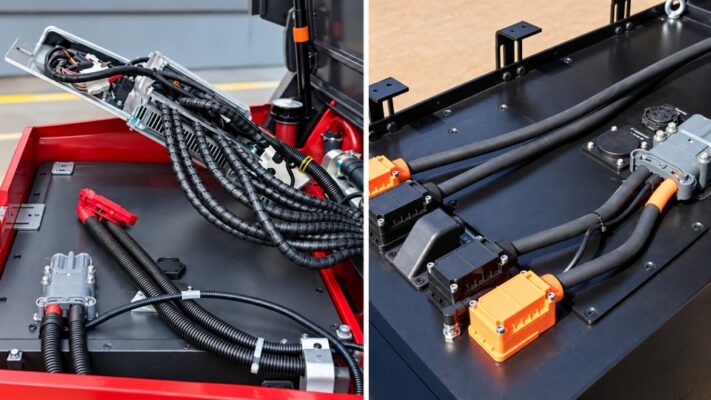
The Series 1294 E30B is an electric counterbalance forklift in the 3.0-tonne class. In the photographed compartment, a metal plate and bolts help locate and retain the battery. Electrical hardware and cable runs are arranged around the same installation zone, with the layout continuing toward the counterweight area.
This is a compact packaging decision. Some forklifts keep the battery zone relatively clear and mount electrical components elsewhere. Others use a different support for the REMA-style connector. Each approach changes how technicians reach the pack, disconnect power, inspect cables and remove the battery.
The useful lesson is not that one layout wins in every application. It is that the compartment must be evaluated as a complete system. A battery that matches the nominal voltage can still create installation problems if its case, cable exits, connector support or service clearances do not match the truck.
Why Forklift Lithium Battery Compartment Design Matters
1. Battery restraint must control movement
An industrial battery is a heavy traction component. Its enclosure must sit against defined locating surfaces, and its restraint must limit movement during travel, braking, turning and load handling. A plate-and-bolt arrangement can provide a clear mechanical stop when it is designed for the pack dimensions and the truck structure.
For a lithium conversion, the new enclosure should not be judged by outside length, width and height alone. Mounting points, retaining plates, access for tools and the sequence for installing or removing the pack also need to be confirmed. BAUFAR uses these measurements when developing custom forklift lithium batteries for a specific truck and compartment.
2. Connector support affects daily handling
A high-current connector should not hang from its cables or sit where it can be struck during service. The connector type, polarity, mounting position and access direction should all be agreed before production. The support also needs enough clearance for a technician to connect and disconnect it without sharply bending the power cables.
This is why our forklift lithium battery components guide treats plugs, cables, displays and service interfaces as part of the battery system rather than optional accessories.
3. Cable routing needs space and protection
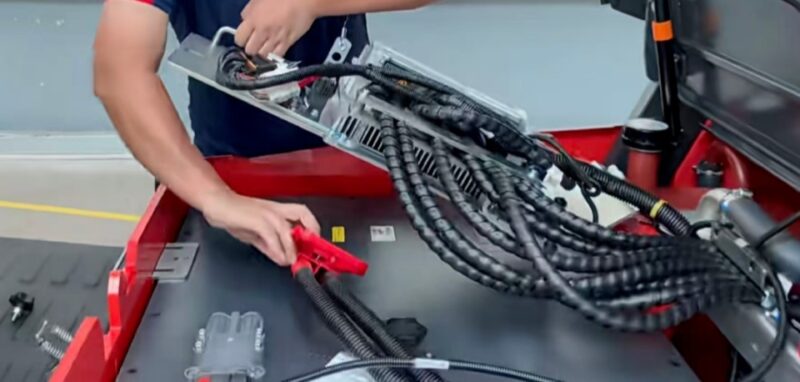
The E30B images show how quickly a battery compartment can become crowded once power cables, protective conduit, connectors and nearby electrical parts share the same space. Cable length must be sufficient for connection and service, but excessive slack can create abrasion, pinch or snag risks.
Before approving a lithium ion forklift battery, check the cable exit direction, bend path and contact points. Cables should stay clear of sharp edges, moving structures and areas where a cover or retaining plate may compress them. Protective sleeving and secure routing are valuable only when the complete installed path has been reviewed.
4. Service access should be planned before delivery
A compact layout can save space, but technicians still need access to fasteners, connectors and inspection points. Ask how the battery will be isolated, how the retaining hardware will be removed and whether adjacent components block routine checks. Also confirm whether removing one part creates strain on another cable or connector.
These questions matter for new forklifts and replacement projects. Buyers comparing an electric forklift battery solution should provide compartment photos, measurements and connector details early, not after the pack has been built.
A Practical Battery-Fit Checklist for Buyers
Mechanical fit
- Measure the usable compartment length, width and height.
- Record the retaining plate, bolt and locating-point positions.
- Confirm the required pack mass range and any counterweight requirement with the truck manufacturer or qualified service provider.
- Check lifting points and the safe installation and removal path.
Electrical fit
- Confirm system voltage, connector model, polarity and current requirement.
- Record cable length, exit direction and protective-conduit needs.
- Confirm charger voltage, charging connector and communication requirements.
- Identify the display, BMS and diagnostic interfaces required by the truck.
Operational fit
- Match capacity to shift length, load profile and charging windows.
- Review ambient temperature, vibration and cleaning conditions.
- Make sure operators and technicians can reach the correct connection and isolation points.
- Document the final installation so future service work does not rely on guesswork.
Our guide to choosing material handling equipment batteries covers the capacity and operating questions that should be reviewed alongside the physical installation.
What Buyers Should Take from the E30B Layout
The Linde E30B example shows that a battery compartment is an engineered interface, not an empty box. Battery restraint, nearby electrical components, connector brackets, cable routing and access all influence whether a lithium battery for forklift use will fit cleanly and remain practical to maintain.
BAUFAR evaluates these details before confirming a custom pack. Clear compartment photos, accurate dimensions, the original battery specification and connector information allow the enclosure, cable exits and interfaces to be planned around the actual truck. That preparation reduces installation uncertainty and gives buyers a battery system designed for the machine rather than a generic box selected by voltage alone.
Featured Forklift LiFePo4 Battery
48V Forklift Battery
51.2v 460Ah Forklift Lithium Battery For BT RR-M6
48V Forklift Battery
Nichiyu FB25PN-75 Forklift Lifepo4 Battery 48V 460Ah
80V Forklift Battery
Forklift Lithium-ion Battery 80v 404Ah for Toyota 7FB30-7FBJ35
48V Forklift Battery
Forklift Lithium Battery 51.2v 404Ah for Still FM-X
48V Forklift Battery
48V 519Ah Lifepo4 Lithium Battery for Heli CPD20/25-GB2/GD Forklift
80V Forklift Battery
80V 404Ah Lifepo4 Lithium Battery for CPD30/35-G1/G3 Forklift
80V Forklift Battery
80V 560AH Lifepo4 Lithium Battery for HELI CPD35-GD2
80V Forklift Battery
80V 600Ah LiFePO4 Lithium Battery for NICHIYU FBC25/30P Forklift