


 Forklift LiFePo4 Battery
 Golf Cart LiFePo4 Battery
 Battery Charger
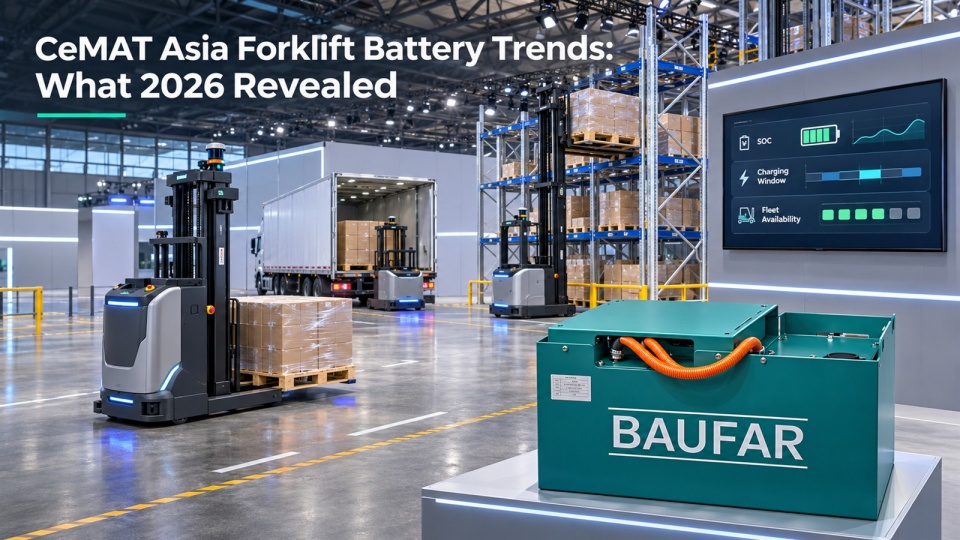
Table of Contents
CeMAT Asia forklift battery trends in 2026 showed a clear shift in autonomous material handling. The industry no longer asks only whether a forklift can move without a driver. Buyers now ask whether the complete system can run every shift, recover from interruptions, charge at the right time and justify its cost.
CeMAT ASIA 2026 ran from November 3 to 6 at the Shanghai New International Expo Centre. The event covered material handling, warehouse technology, transport systems and logistics automation. Autonomous forklifts appeared in loading, pallet transport, high-bay storage and narrow-aisle demonstrations.
From BAUFAR’s battery-engineering perspective, the important change happened behind the visible robot. A forklift robot must manage energy as part of its mission. Pack capacity, peak power, charging strategy, BMS communication and service response all influence whether the vehicle can complete its assigned work.
CeMAT Asia Forklift Battery Trends Moved Beyond Runtime
Conventional battery discussions often start with one question: how many hours will the forklift run? Autonomous fleets need a more detailed answer. The battery must support a defined sequence of travel, lifting, waiting, queuing and charging. Each task changes energy use and power demand.
A robot may spend less time idling with an operator, yet it can work more hours per day. High utilization increases daily energy demand. Frequent acceleration, lifting and high-bay travel also create peak loads. Battery sizing therefore needs mission data, not a simple shift-length estimate.
BAUFAR’s guide to lithium forklift daily electricity use explains how operating hours, average load and charging losses help establish a realistic energy baseline.
Four Exhibition Routes, Four Battery Priorities
The Shanghai demonstrations showed several routes toward autonomous pallet handling. Each route creates a different battery requirement.
1. Broad autonomous forklift platforms
Full product ranges can cover pallet trucks, stackers, reach trucks and counterbalance forklifts. A platform supplier benefits from common software and service tools. The battery side also needs a platform approach.
Different trucks may use different voltage, capacity and peak-current levels. However, fleets still benefit from common communication rules, diagnostic fields, charging logic and fault codes. Standard data reduces integration work and helps service teams compare vehicles.
2. Loading and unloading applications
Truck loading creates unpredictable routes, changing pallet positions and limited space. The forklift may accelerate, brake, steer and lift more often than a vehicle on a fixed warehouse loop. These actions can raise both peak current and energy variability.
Battery specifications for this duty should include low-SOC power capability, voltage stability under load and thermal behavior during repeated peaks. Designers must also protect cables, connectors and enclosures against vibration and impact.
3. Rapid-deployment pallet transport
Standard pallet movement aims to shorten commissioning and reduce project cost. A repeatable battery interface supports that goal. The vehicle still needs verified voltage limits, connectors, mounting, CAN messages and charger compatibility.
Fast vehicle deployment does not remove site work. Teams must assess charging locations, electrical supply, traffic rules and network recovery. A thirty-minute robot setup means little if the charging plan requires weeks of redesign.
4. High-bay and narrow-aisle storage
High lift heights make stability and accurate control essential. Battery mass can affect the vehicle’s weight distribution, while voltage drop can affect lift performance at low SOC. Narrow aisles also limit access for service.
These applications need clear pack dimensions, mass, centre of gravity, restraint points and cable routing. Buyers should also review service access before installation. A battery that fits the compartment can still create maintenance problems.
Opportunity Charging Becomes Part of Fleet Control
Autonomous forklifts can charge without waiting for an operator. That advantage changes fleet planning. The scheduler can send a vehicle to charge during a break, a queue or a low-demand period.
However, the software cannot ignore battery limits. Charging current depends on cell temperature, SOC, charger output and the validated pack design. Current often tapers near the upper SOC range. Sending every vehicle to charge at the same threshold may also create a site-power peak.
A better strategy links task demand with battery data. The fleet manager can reserve high-SOC vehicles for long missions, direct low-SOC vehicles to short jobs and spread charging across available stations. BAUFAR’s article on the forklift lithium battery charging curve explains why charging time does not follow one constant rate.
Charging infrastructure must match fleet scale
One charger may support a demonstration. A production fleet needs enough charging capacity for its busiest operating window. Site planners should calculate simultaneous charging load, cable routes, protected parking positions and recovery procedures after a charger fault.
The plan should also define who controls the charge decision. The vehicle controller, fleet software, charger and BMS must exchange consistent information. Conflicting SOC values or fault states can stop an otherwise healthy robot.
BMS Data Joins the Automation Stack
An autonomous forklift depends on software layers such as task management, traffic control and warehouse systems. Battery data belongs in the same architecture. The BMS can provide SOC, current, cell voltage, temperature, alarms and charge permission.
Useful data must lead to clear actions. The system should know when to reduce power, postpone a mission, request charging or remove a vehicle from service. It should also distinguish a temporary temperature limit from a fault that needs inspection.
Communication design matters as much as the connector. Engineers should document CAN identifiers, update rates, timeout behavior, alarm priority and safe fallback states. BAUFAR’s article on forklift lithium battery technology in the AI era describes how battery intelligence can support smarter vehicle decisions.
Availability Matters More Than a Headline Cycle Number
Trade-show displays can demonstrate navigation, sensing and lifting. Real warehouses judge a system over months and years. Battery performance contributes to that result through more than nominal cycle life.
Fleet availability depends on usable energy, charge access, thermal limits, fault recovery and service time. A pack with a long laboratory cycle result can still reduce productivity if a connector overheats or a communication fault blocks charging. Buyers should request the conditions behind every life claim.
Relevant conditions include temperature, charge rate, discharge rate, depth of discharge and end-of-life capacity. The warranty should also match the planned duty. A multi-shift robot fleet may accumulate cycles and operating hours much faster than a single-shift manual fleet.
The Business Case Needs Battery-Level Numbers
CeMAT ASIA 2026 reinforced a commercial reality: customers want measurable automation. A vehicle that moves autonomously still needs to reduce labour exposure, improve throughput, increase storage density or support safer operations.
The battery affects several cost lines:
- Number of vehicles needed to meet peak demand.
- Daily electricity use and charging losses.
- Charger quantity and electrical infrastructure.
- Battery service, diagnostics and replacement time.
- Downtime caused by energy shortages or faults.
- Residual capacity and replacement timing.
Buyers should compare cost per productive pallet movement or operating hour, not only battery purchase price. BAUFAR’s lithium forklift battery TCO guide provides a structure for acquisition, energy, maintenance, infrastructure and downtime costs.
Battery Questions to Ask After CeMAT ASIA 2026
Energy and power
- What mission profile supports the stated runtime?
- What are the continuous and peak current limits?
- How does low SOC affect travel and lift power?
- Which temperature conditions cause derating?
Charging and fleet integration
- Which SOC and temperature windows allow opportunity charging?
- How do the BMS, charger and fleet manager exchange data?
- What happens after communication or charger failure?
- How many vehicles can charge at the same time?
Mechanical and service design
- Does the pack meet the truck’s mass and centre-of-gravity requirements?
- How does the enclosure resist vibration, impact, dust and moisture?
- Can technicians access fuses, contactors and communication ports?
- Which diagnostic records support remote service?
What CeMAT ASIA 2026 Means for Forklift Batteries
The Shanghai exhibition showed that autonomous forklifts are becoming operational systems rather than isolated machines. Loading, narrow-aisle storage, high-bay work and standard pallet transport will not use one identical battery. Each application needs a validated combination of energy, power, charging and mechanical integration.
At the same time, the software layer will demand more consistent battery data. Fleet managers need reliable SOC, charge permission, temperature limits and fault status. Service teams need traceable events and clear recovery procedures.
From BAUFAR’s perspective, the most important CeMAT Asia forklift battery trends all point in one direction. The battery must become a predictable part of the automation platform. When the pack supports mission planning, controlled opportunity charging and fast diagnosis, the autonomous forklift has a better chance of becoming reliable logistics infrastructure.
“`
Featured Forklift LiFePo4 Battery
48V Forklift Battery
51.2v 460Ah Forklift Lithium Battery For BT RR-M6
48V Forklift Battery
Nichiyu FB25PN-75 Forklift Lifepo4 Battery 48V 460Ah
80V Forklift Battery
Forklift Lithium-ion Battery 80v 404Ah for Toyota 7FB30-7FBJ35
48V Forklift Battery
Forklift Lithium Battery 51.2v 404Ah for Still FM-X
48V Forklift Battery
48V 519Ah Lifepo4 Lithium Battery for Heli CPD20/25-GB2/GD Forklift
80V Forklift Battery
80V 404Ah Lifepo4 Lithium Battery for CPD30/35-G1/G3 Forklift
80V Forklift Battery
80V 560AH Lifepo4 Lithium Battery for HELI CPD35-GD2
80V Forklift Battery
80V 600Ah LiFePO4 Lithium Battery for NICHIYU FBC25/30P Forklift