


 Forklift LiFePo4 Battery
 Golf Cart LiFePo4 Battery
 Battery Charger
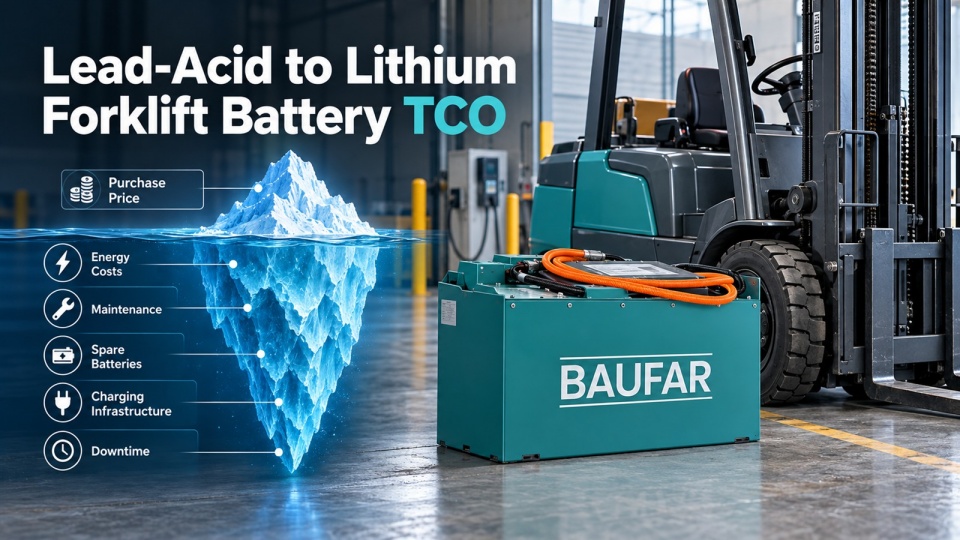
Table of Contents
A lead-acid to lithium forklift battery TCO comparison should answer one practical question: which system costs less to deliver the required truck availability over the selected ownership period? The invoice price is only the first line. Energy, labor, replacement batteries, charging space, battery changes, downtime and conversion work can materially change the result.
There is no honest universal payback period. A two- or three-shift distribution center may value opportunity charging and reduced battery changing very differently from a truck that runs lightly for one shift. BAUFAR therefore recommends building the comparison from the fleet’s own operating records rather than copying a percentage from a sales brochure.
What Belongs in Forklift Battery TCO?
A useful calculation covers the full evaluation period and applies the same boundaries to both technologies. At minimum, include:
- Initial battery, charger and installation cost.
- Replacement batteries expected within the evaluation period.
- Electricity purchased at the meter, including charging losses.
- Routine inspection, watering, cleaning and equalization labor where applicable.
- Battery-changing equipment, spare packs and the space used to store or charge them.
- Downtime caused by charging, battery changes or unavailable equipment.
- Conversion engineering, communication integration, ballast and compartment work.
- Training, safety controls, financing, residual value and disposal or recycling.
The basic model is:
TCO = acquisition + replacements + energy + maintenance + infrastructure + downtime + conversion and compliance costs − residual value.
Use discounted cash flow when the project is large or the evaluation period is long. A cost paid in year seven should not be treated exactly like a cost paid today. BAUFAR’s guide to lithium forklift battery cost and TCO provides additional context for separating purchase price from operating cost.
Start With the Duty Cycle, Not the Battery Quote
Record truck hours and energy demand
Collect several weeks of operating data for each truck class. Record shift length, key-on hours, productive hours, lift frequency, average load, travel distance, idle time, ambient temperature and current battery use. A nameplate capacity is not the same as daily energy consumption.
For the energy line, use charger input measured at the AC meter whenever possible. The cost formula is simple:
Annual electricity cost = annual charger input kWh × blended electricity rate.
Do not compare one battery’s nominal kWh with another battery’s charger input. The boundary must be the same. Demand charges, time-of-use tariffs and charger standby consumption may also matter. BAUFAR’s article on forklift battery charging costs explains the variables that should be captured.
Separate single-shift and multi-shift vehicles
A lightly used single-shift truck may have enough overnight charging time and may not require a spare battery. In that case, a serviceable lead-acid system can remain economically reasonable, especially when the existing charger and battery room are already sunk costs.
A high-utilization multi-shift truck has a different cost structure. If the lead-acid operating plan requires battery changes, spare packs, handling equipment and dedicated labor, those items belong in the baseline. A correctly sized lithium system may use planned opportunity charging during breaks, but only if the charger, site power, battery temperature limits and operating schedule support it.
Five Cost Lines That Commonly Change the Result
1. Battery quantity and replacement timing
Compare the number of packs required per truck, not just the price per pack. Then estimate replacement timing from documented cycle life, depth of discharge, temperature, charging practice and warranty terms. Avoid assuming that every pack will reach a headline cycle number. The forecast should include a conservative case and a high-stress case.
2. Maintenance labor and materials
Lead-acid programs may include electrolyte checks, watering, equalization, terminal cleaning and corrosion control. The cost is the loaded labor rate multiplied by verified time, plus water systems, PPE, cleaning materials and service calls. Lithium batteries remove watering and equalization, but they are not maintenance-free assets: connectors, cables, mounting, cooling paths, event logs and BMS faults still require inspection.
3. Charging and battery-room infrastructure
Existing infrastructure has a different economic treatment from new infrastructure. If a facility already owns a compliant battery room, hoist and chargers, their original purchase price is sunk; future maintenance and replacement are not. For a new site, compare ventilation, acid-handling provisions, eyewash equipment, battery-changing equipment and floor space with the electrical service, lithium chargers, cable management and protective layout required by the alternative.
4. Downtime and labor for battery changes
Downtime should be valued only when it affects output or requires another truck. Measure the minutes per battery change, changes per year and the real cost of the affected labor or production. Do not assign a dramatic lost-production value to a truck that can charge during a scheduled idle period.
5. Failure risk and service response
Unexpected failures can dominate a small fleet’s economics. Include warranty scope, local parts, diagnostic access, response time and whether a loan pack is available. A low purchase price can become expensive if the battery, charger and truck supplier each blame the other during a communication fault.
Lead-Acid to Lithium Forklift Battery TCO Worksheet
Use one row per truck class and calculate low, expected and high cases. The following inputs are more useful than a generic savings claim:
- Number of trucks and operating shifts.
- Measured annual charger input kWh per truck.
- Electricity and demand-charge assumptions.
- Battery and charger quantity, price and expected replacement year.
- Annual maintenance hours and loaded labor rate.
- Battery-change minutes and changes per year.
- Required spare trucks or spare batteries.
- Floor-space cost and infrastructure renewal cost.
- Conversion, approval, installation and training cost.
- Discount rate, evaluation period and residual value.
Calculate the difference year by year. The payback point is the first year in which cumulative discounted lithium cost falls below cumulative discounted lead-acid cost. Also show the result per productive truck hour or per pallet moved. That makes comparisons across different utilization levels more meaningful.
Conversion Costs Must Be Included Before Approval
A lithium pack is not approved merely because its nominal voltage and compartment dimensions appear similar. The conversion review should confirm the full charge and discharge voltage range, continuous and peak current, connector rating, charger profile, BMS communication, low-SOC behavior and fault handling. BAUFAR’s forklift lithium battery components guide outlines the interfaces that buyers should document.
Battery mass and restraint
The original battery may contribute to truck counterweight and stability. A lighter lithium pack can require engineered ballast, but ballast must never be improvised. The completed battery assembly must also be securely restrained, fit the compartment and preserve service access. Any change that can affect capacity or safe operation should be handled through the truck manufacturer’s approval process and applicable local requirements.
Charger and communication
Do not reuse a lead-acid charger unless it has been specifically validated and configured for the lithium battery by the responsible suppliers. Charging voltage, current, termination logic and communication must match the battery. A lithium charger cannot compensate for an incompatible truck controller, connector or wiring system.
Compartment geometry, cable routing, ventilation, display integration and mounting details can create real installation cost. BAUFAR’s battery compartment design guide shows why fit must be verified as an engineering package rather than by length, width and height alone.
When Does Lithium Usually Have the Stronger Business Case?
Lithium tends to gain economic leverage where trucks have high annual hours, multiple shifts, frequent battery changes, expensive downtime, limited battery-room space or useful charging windows during breaks. The case becomes stronger when one validated pack can replace a lead-acid operating plan that depends on multiple rotating packs.
The decision may remain close where utilization is low, labor is inexpensive, the existing lead-acid system is well maintained and the site already owns suitable infrastructure. A staged pilot is often better than converting the whole fleet at once. Choose a high-utilization truck, record AC energy, availability, faults and service time for several months, then replace assumptions in the model with site data.
BAUFAR’s TCO Decision Checklist
- Use the same ownership period, energy boundary and productivity target for both options.
- Base energy and labor on measured fleet data.
- Count every required battery, charger, spare and handling device.
- Model conservative, expected and demanding operating cases.
- Include conversion engineering, approvals, ballast and integration.
- Verify warranty conditions against temperature, C-rate and duty cycle.
- Run a pilot before a large fleet rollout when important inputs remain uncertain.
The correct lead-acid to lithium forklift battery TCO result is not a preset percentage. It is a transparent model that connects battery engineering with the fleet’s actual work. When energy, maintenance, infrastructure, downtime and conversion risk are all visible, the buyer can decide whether lithium creates measurable value—or whether the present lead-acid system should remain in service for now.
Featured Forklift LiFePo4 Battery
48V Forklift Battery
51.2v 460Ah Forklift Lithium Battery For BT RR-M6
48V Forklift Battery
Nichiyu FB25PN-75 Forklift Lifepo4 Battery 48V 460Ah
80V Forklift Battery
Forklift Lithium-ion Battery 80v 404Ah for Toyota 7FB30-7FBJ35
48V Forklift Battery
Forklift Lithium Battery 51.2v 404Ah for Still FM-X
48V Forklift Battery
48V 519Ah Lifepo4 Lithium Battery for Heli CPD20/25-GB2/GD Forklift
80V Forklift Battery
80V 404Ah Lifepo4 Lithium Battery for CPD30/35-G1/G3 Forklift
80V Forklift Battery
80V 560AH Lifepo4 Lithium Battery for HELI CPD35-GD2
80V Forklift Battery
80V 600Ah LiFePO4 Lithium Battery for NICHIYU FBC25/30P Forklift