


 Forklift LiFePo4 Battery
 Golf Cart LiFePo4 Battery
 Battery Charger
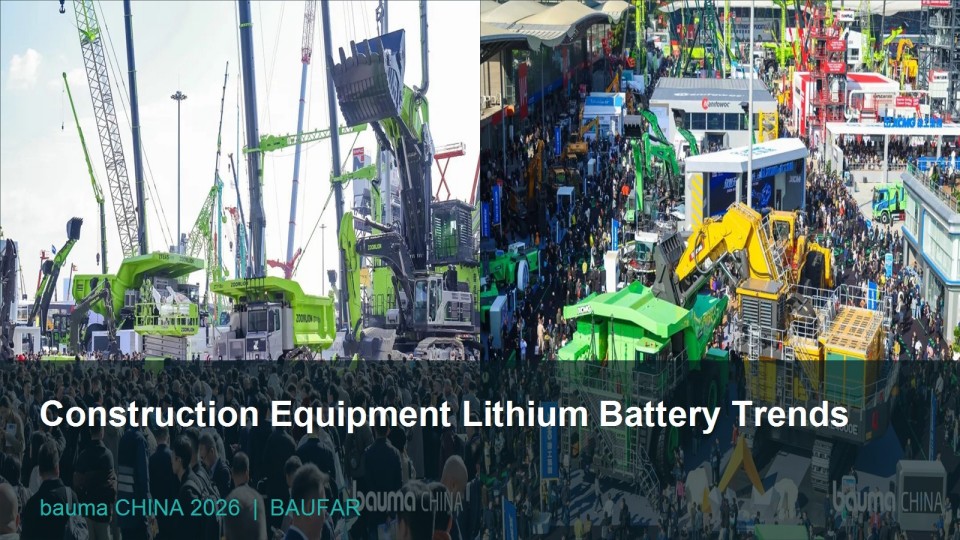
Table of Contents
Construction equipment lithium battery trends were hard to miss at bauma CHINA 2026. Construction equipment lithium battery trends point to a broader shift toward electric and non-fuel machinery, alongside the battery and control suppliers supporting that transition. For BAUFAR, the practical takeaway is clear: electrification succeeds when the battery, vehicle, charger and work cycle are engineered as one system. That lesson applies to forklift fleets as much as to other industrial equipment.
What construction equipment lithium battery trends signal
The reported show brought together a wide range of machinery and suppliers across two exhibition venues. Its coverage described a strong presence of electric equipment and participation from battery and intelligent-control companies. These observations point to growing investment in electrification, but a trade-show display alone cannot establish real-world efficiency, uptime or lifetime cost. Buyers still need application data and verified specifications.
These construction equipment lithium battery trends also change more than the energy source. It brings battery packaging, thermal limits, controls, charging infrastructure, service planning and machine integration into the purchasing decision. Those are familiar engineering questions for industrial traction batteries.
Construction equipment lithium battery trends: system integration
A lithium pack must match the machine’s voltage window, continuous and peak current, duty cycle, environmental conditions and physical installation. The battery management system must coordinate protection and operating limits with the vehicle and charger. Connectors, wiring, communications and commissioning all affect whether the equipment can work reliably in its intended role.
BAUFAR’s guide to forklift lithium battery components and setup explains how the pack, plugs, display and system configuration fit together.
Apply construction equipment lithium battery trends to forklift fleets
Construction sites and warehouses have different duty cycles, but fleet managers in both settings need to size batteries around measured work. For forklifts, record shift length, load profile, lift frequency, travel distance, idle time and available charging windows. Use those inputs to compare pack capacity, charging strategy and the need for spare batteries.
High-voltage applications add another layer of system checks. Confirm that the battery’s full operating range and current limits suit the truck controller and charger; nominal voltage by itself is not enough. See BAUFAR’s overview of high-voltage forklift lithium batteries for the main selection considerations.
Evaluate the whole operating system
Before choosing a battery, check the equipment maker’s requirements, mounting and weight limits, charging infrastructure, service access and local safety rules. Then compare total cost over a consistent period, including the pack, charger, installation, energy, maintenance, downtime and replacement planning. A pilot in representative operating conditions can expose integration issues before a fleet-wide rollout.
For demanding applications, review the vehicle’s load profile and installation envelope alongside the battery specifications. BAUFAR’s heavy-duty forklift lithium battery guide covers considerations for higher-demand work.
From exhibition interest to measurable results
For official exhibition information, visit the bauma CHINA website. bauma CHINA 2026 provides a snapshot of an industry investing in electrification. The useful next step for buyers is to turn that interest into engineering questions: What energy does the duty cycle require? Which charger and communication protocol does the machine support? How will the battery be secured, monitored and serviced? Answering those questions helps fleets choose lithium systems on fit and operating evidence rather than exhibition excitement alone.
Featured Forklift LiFePo4 Battery
48V Forklift Battery
51.2v 460Ah Forklift Lithium Battery For BT RR-M6
48V Forklift Battery
Nichiyu FB25PN-75 Forklift Lifepo4 Battery 48V 460Ah
80V Forklift Battery
Forklift Lithium-ion Battery 80v 404Ah for Toyota 7FB30-7FBJ35
48V Forklift Battery
Forklift Lithium Battery 51.2v 404Ah for Still FM-X
48V Forklift Battery
48V 519Ah Lifepo4 Lithium Battery for Heli CPD20/25-GB2/GD Forklift
80V Forklift Battery
80V 404Ah Lifepo4 Lithium Battery for CPD30/35-G1/G3 Forklift
80V Forklift Battery
80V 560AH Lifepo4 Lithium Battery for HELI CPD35-GD2
80V Forklift Battery
80V 600Ah LiFePO4 Lithium Battery for NICHIYU FBC25/30P Forklift