


 Forklift LiFePo4 Battery
 Golf Cart LiFePo4 Battery
 Battery Charger
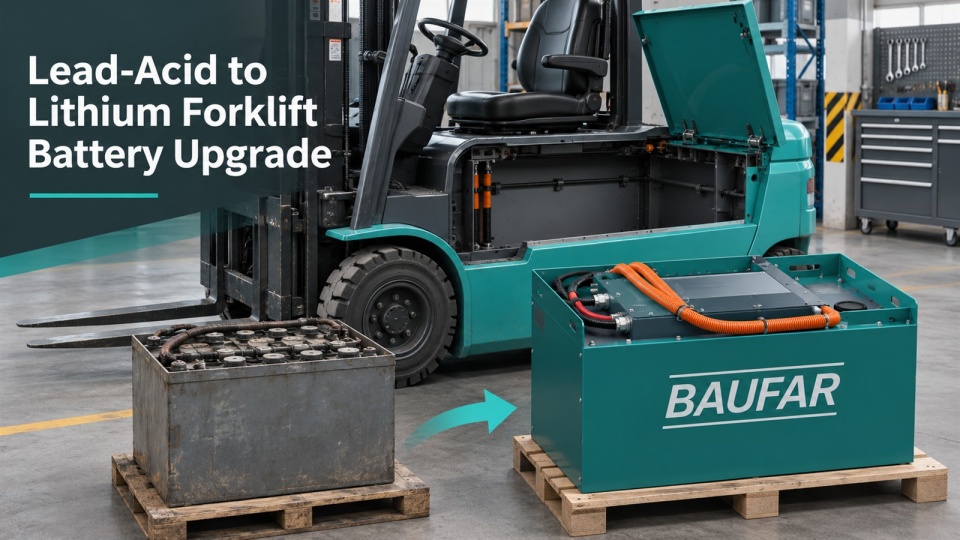
Table of Contents
A lead-acid to lithium forklift battery upgrade can reduce battery handling and create more flexible charging, but the conversion must fit the truck and its work cycle. Start with the operating data, then verify voltage, charger settings, BMS communication, battery weight, mounting and the truck manufacturer’s requirements. A lithium pack that only fits the compartment may still be a poor or unsafe conversion.
At BAUFAR, we evaluate a conversion as a complete traction system. The goal is not simply to exchange one battery chemistry for another. The battery must deliver the required energy and peak power, communicate correctly with the truck and charger, and preserve the vehicle’s safe operating characteristics.
When Does a Forklift Battery Upgrade Make Sense?
Lead-acid batteries can remain practical for low-utilization trucks with overnight charging, trained maintenance staff and suitable charging facilities. A conversion becomes more attractive when a fleet changes batteries frequently, runs multiple shifts, loses productive time to charging or wants to reduce routine watering and equalization work.
These benefits depend on the site. Opportunity charging only helps when the work schedule includes predictable breaks and the battery supports the planned charge rate. Reduced maintenance does not eliminate inspections, connector checks or fault diagnosis. A conversion decision should compare both technologies over the same ownership period.
BAUFAR’s guide to forklift lead-acid batteries outlines the operating practices and infrastructure that belong in the current-system baseline.
Start With the Truck’s Real Duty Cycle
Collect data for each truck model and operating pattern. Record shift length, productive hours, average load, lift frequency, travel distance, idle periods, ambient temperature and charger input energy. Include heavy-load periods because traction and hydraulic peaks can exceed the average demand by a wide margin.
Use measured energy consumption to size the pack. Do not choose capacity from a vehicle’s advertised runtime alone. A practical review should identify:
- Daily energy use and the required reserve at shift end.
- Continuous and peak discharge current, including peak duration.
- Charging opportunities and the available charging window.
- Ambient and cell-temperature conditions.
- Whether the truck returns to a fixed charger or needs distributed charging.
For a broader cost model, see BAUFAR’s forklift lithium battery TCO guide. It helps compare acquisition, electricity, maintenance, infrastructure and downtime.
Check Electrical Compatibility Before Ordering
Voltage range matters more than the nominal label
Confirm the truck’s minimum and maximum DC voltage limits, not only the battery’s nominal voltage. The battery’s full charge and discharge range must stay within the limits of the inverter, motor controller, display and auxiliary converters. An apparently similar nominal voltage does not guarantee compatibility.
Match current, connectors and protection
Compare the battery’s continuous and peak current limits with traction, lift and steering loads. Check connector ratings, cable size, fuse protection, contactors and precharge behavior. Engineers should also confirm polarity, isolation and emergency-disconnect arrangements before commissioning.
Coordinate the charger and BMS
A lithium battery needs a charging profile approved for its cell chemistry and pack design. The charger must use the correct voltage limits, current limits and charge-termination logic. The BMS should report charge permission, temperature limits, SOC and fault status through a documented communication protocol when the system requires it.
Do not assume a lead-acid charger can safely charge a lithium pack. Confirm charger compatibility with the battery and truck suppliers. BAUFAR’s forklift battery components guide explains why pack, plugs, display, charger and setup need to work together.
Battery Weight Can Affect Forklift Stability
The original lead-acid battery may serve as part of the truck’s counterweight. A replacement lithium pack can have a different mass, shape or center of gravity. Before installation, compare the approved battery weight range, compartment dimensions, restraint points and the truck manufacturer’s instructions.
Do not add improvised ballast to make up a weight difference. Any change that affects capacity or safe operation may require written approval and updated truck markings under applicable rules. In the United States, OSHA’s powered industrial truck standard requires prior written manufacturer approval for modifications that affect capacity or safe operation.
Also check enclosure strength, vibration resistance, cable routing, terminal clearance and service access. A pack that fits dimensionally still needs secure mounting and a safe maintenance procedure.
Recalculate the Charging Area and Site Power
Lithium charging can create more flexible charging schedules, but it does not make site power unlimited. Estimate the number of trucks that may charge at the same time, charger input power, electrical-panel capacity and cable protection. For multi-shift fleets, coordinate charger availability with the work schedule.
Lead-acid facilities may include designated charging areas, ventilation and battery-handling equipment. A lithium conversion can change those requirements, but site rules and local codes still apply. Review the charging layout with qualified electrical and safety personnel rather than removing existing controls by assumption.
Build a Comparable Total Cost Model
Compare the current lead-acid system with the proposed lithium system over the same time horizon. Include:
- Battery and charger purchase and installation.
- Replacement timing and expected residual value.
- Measured electricity use and charging losses.
- Maintenance labor, consumables and service calls.
- Spare batteries, changing equipment and storage space.
- Downtime that affects production or requires another truck.
- Conversion engineering, approvals, ballast and integration.
Use site data wherever possible. A low-use single-shift truck may not recover a higher purchase price quickly. A truck that works several shifts and relies on spare batteries may show a different result. Avoid applying one universal savings percentage to every operation.
Plan a Controlled Pilot Before Fleet Rollout
Select one representative truck and document its baseline before conversion. During the pilot, record energy use, charging time, availability, fault events, temperature behavior and operator feedback. Confirm that the truck maintains its approved capacity and handling characteristics.
Set acceptance criteria before the trial begins. These may include a minimum daily energy reserve, successful charger communication, stable peak-load performance, service response time and a measured change in battery-related labor. A pilot reveals integration gaps while limiting disruption to the wider fleet.
Lead-Acid to Lithium Forklift Battery Upgrade Checklist
- Measure the real duty cycle and daily energy demand.
- Verify pack voltage range, current limits and peak-load duration.
- Confirm charger profile, BMS protocol and truck-controller compatibility.
- Check battery mass, center of gravity, mounting and truck approval.
- Review charging locations, electrical capacity and site safety requirements.
- Compare total cost using the same ownership period and operating assumptions.
- Run a documented pilot before converting the full fleet.
A well-planned lead-acid to lithium forklift battery upgrade can support higher utilization and simpler charging operations. The result depends on system compatibility and the fleet’s actual work, so validate the complete installation before treating the conversion as a standard battery replacement.
Featured Forklift LiFePo4 Battery
48V Forklift Battery
51.2v 460Ah Forklift Lithium Battery For BT RR-M6
48V Forklift Battery
Nichiyu FB25PN-75 Forklift Lifepo4 Battery 48V 460Ah
80V Forklift Battery
Forklift Lithium-ion Battery 80v 404Ah for Toyota 7FB30-7FBJ35
48V Forklift Battery
Forklift Lithium Battery 51.2v 404Ah for Still FM-X
48V Forklift Battery
48V 519Ah Lifepo4 Lithium Battery for Heli CPD20/25-GB2/GD Forklift
80V Forklift Battery
80V 404Ah Lifepo4 Lithium Battery for CPD30/35-G1/G3 Forklift
80V Forklift Battery
80V 560AH Lifepo4 Lithium Battery for HELI CPD35-GD2
80V Forklift Battery
80V 600Ah LiFePO4 Lithium Battery for NICHIYU FBC25/30P Forklift